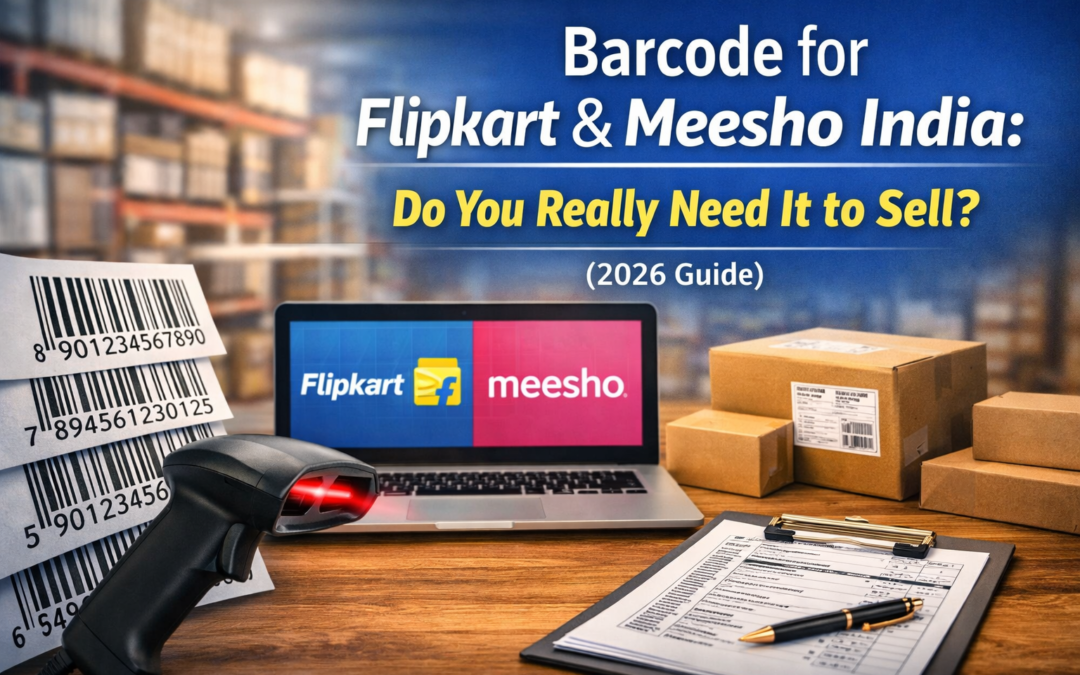
When someone starts selling online in India, the focus is usually on product selection, pricing, and margins. Barcode is rarely part of that initial thinking.
In fact, most sellers only start worrying about it when something goes wrong — a listing doesn’t go live, inventory becomes confusing, or scaling to multiple products becomes messy.
If you’re planning to sell on Flipkart or Meesho, it’s worth understanding this properly before you begin.
Because barcode is not just a requirement — it’s part of how your business is structured behind the scenes.
What a Barcode Actually Does in Online Selling
A barcode is simply a unique number assigned to a product. But in practical terms, it does much more than that.
It tells systems what your product is, how it should be tracked, and ensures that it doesn’t get mixed up with something else.
When you start with one or two products, this may not feel important. But once you have five, ten, or twenty products, things change quickly.
Without proper identification, even simple tasks like tracking stock or updating listings can become unnecessarily complicated.
Flipkart: Where Barcode Becomes Important
On Flipkart, barcode is not something you can ignore for long.
If you are listing a new product — especially under your own brand — the platform expects a proper product identifier.
This is where most sellers face friction. They try to list without a barcode, or use incomplete data, and the listing either doesn’t go live properly or creates duplicate entries.
From experience, it’s always smoother to start with a proper barcode rather than trying to fix things later.
Meesho: Why Sellers Get Confused
Meesho gives a bit more flexibility in the beginning.
You can list products without worrying too much about barcode initially. That’s why many new sellers assume it’s not necessary at all.
But this flexibility only works at a very small scale.
As soon as you start handling multiple products, managing variations, or trying to expand to other platforms, the lack of a proper system becomes visible.
What felt like a shortcut at the beginning turns into a limitation later.
The Turning Point Most Sellers Experience
There’s a stage every seller reaches.
At first:
- You have a few products
- Orders are manageable
- Everything feels simple
Then gradually:
- Product count increases
- Orders grow
- Returns and tracking become more frequent
This is when structure starts to matter.
Sellers who started without barcode often find themselves reorganizing everything. Those who started with it don’t face that problem.
Why Experienced Sellers Don’t Skip Barcode
If you speak to sellers who have been in the business for a while, you’ll notice a pattern.
They don’t treat barcode as optional.
Not because the platform forces them, but because it simplifies everything.
It allows them to:
- Keep their catalog organized
- Track inventory accurately
- Move across platforms without friction
- Maintain consistency in their product data
It’s less about compliance and more about control.
Choosing the Right Barcode Format
In India, the most practical format for sellers is EAN-13.
It is widely used across retail systems, inventory software, and online platforms.
The advantage of using the right format from the beginning is that you don’t have to think about compatibility later.
Your product data works wherever you take it — whether that’s another marketplace, a warehouse system, or even offline retail.
One Barcode, Multiple Uses
This is something many beginners overlook.
A barcode is not tied to a single platform.
Once assigned to your product, it can be used across:
- Different marketplaces
- Inventory systems
- Packaging and labeling
- Billing and tracking
This makes it more of a long-term asset than a one-time requirement.
Common Mistakes That Cause Problems Later
A few patterns come up repeatedly with new sellers.
One is delaying the decision entirely. It feels easier to start without barcode, but the cost shows up later in the form of time and confusion.
Another is using inconsistent or duplicate codes. This creates problems that are difficult to fix once your catalog grows.
And then there’s the mindset of “I’ll figure it out later,” which usually leads to rework when the business starts picking up.
When It Makes Sense to Get a Barcode
If you are:
- Launching your own product
- Planning to sell on multiple platforms
- Building a catalog beyond a few items
Then it makes sense to get a barcode before you list your product.
It keeps things clean from the beginning and avoids unnecessary adjustments later.
Thinking Beyond the First Few Orders
It’s easy to think in terms of immediate needs.
Most sellers ask: “Can I list my product today?”
A better question is: “Will this setup still work when I have 50 products?”
That shift in thinking changes how you approach small decisions like barcode.
Because what seems optional in the beginning often becomes essential as you grow.
Final Take
Selling on Flipkart and Meesho is not just about getting your first few orders.
It’s about building a system that can handle growth.
A barcode may look like a small detail, but it plays a role in how smoothly your business operates over time.
Getting it right early means you spend less time fixing things later.
Continue Reading: EAN-13 Guides
Explore practical guides for product identification, packaging and retail preparation.
 Barcode for Clothing Products in India: EAN-13 Guide
Read guide →
Barcode for Clothing Products in India: EAN-13 Guide
Read guide →
 Why Retailers Reject Products With Barcode Problems | India Guide
Read guide →
Why Retailers Reject Products With Barcode Problems | India Guide
Read guide →
 Barcode for Multipack Products in India: Do You Need a New One?
Read guide →
Barcode for Multipack Products in India: Do You Need a New One?
Read guide →
 Why Is My Barcode Not Scanning? 11 Common EAN-13 Problems & Solutions
Read guide →
Why Is My Barcode Not Scanning? 11 Common EAN-13 Problems & Solutions
Read guide →