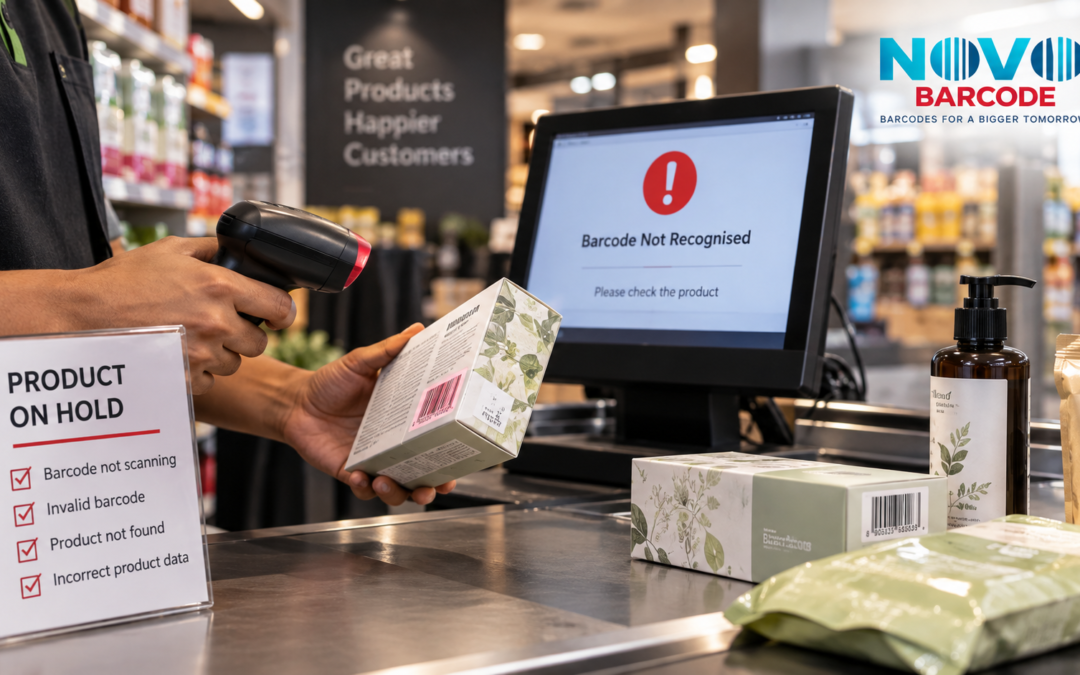
A retailer does not usually notice a barcode when everything is working properly. The product arrives, it is added to the system, the barcode is scanned, the right product appears on the screen and the sale continues. The barcode becomes important only when something goes wrong.
That can happen in a surprisingly small number of ways. A scanner may struggle to read the printed symbol. The barcode may point to the wrong product record. A product variant may have been given the wrong identifier. The barcode may be placed badly on the packaging. Or the number itself may not meet the requirements of the retailer or sales channel.
For a brand that has just spent money on manufacturing and packaging, discovering the problem at this stage can be particularly frustrating. The packaging may look perfect. The barcode may even scan when tested with a mobile phone. Yet the retailer can still come back asking for clarification or a corrected product.
The important thing to understand is that a barcode is not simply a black-and-white picture printed on a box. It is the link between the physical product and the product information behind it. When that link is unreliable, the retailer has a reason to stop and investigate.
What a Retailer Actually Needs From a Barcode
Think about what happens when a product reaches a retail store.
The retailer needs to know what the product is, which product record it belongs to, how it should be counted in inventory and what should happen when the barcode is scanned at the checkout or during stock handling.
The barcode therefore has two jobs in practical terms.
First, the printed symbol needs to be readable. Second, the identifier needs to correspond to the correct product information.
These two things are often confused.
A barcode can be perfectly readable and still be associated with the wrong product data. Likewise, the product information can be completely correct while the printed barcode is too poorly produced to scan reliably.
GS1 India’s GTIN Validation service exists specifically because retailers and data aggregators need to validate product identifiers and associated product information. Invalid or inconsistent product data can lead to inventory and transaction problems.
The Barcode Scans, But the Retailer Still Has a Problem
This is probably the most misunderstood part of barcode acceptance.
A business owner prints a barcode, opens a phone app, points the camera at it and sees the number appear. From the business owner’s perspective, the barcode is working.
But that test answers only one question:
Can this particular device read this particular print at this particular moment?
It does not necessarily answer whether the printed symbol meets the quality requirements of the intended scanning environment.
A retail scanner may encounter the barcode at a different angle, under different lighting, after the package has been handled, or after the printed surface has picked up scratches, creases or reflections.
GS1 India specifically notes that simply scanning a barcode at your own end does not guarantee that it will work with every scanner. Barcode verification is intended to examine the printed symbol against quality parameters before large-scale production and supply.
That distinction can save a business from a very expensive lesson.
A Small Barcode Is Not Always a Better Barcode
Packaging designers often work under pressure. There is the brand name, product description, ingredients, nutritional information, MRP, manufacturer details, promotional messaging and several other elements competing for space.
The barcode sometimes ends up being treated as the easiest element to shrink.
It fits neatly into a smaller corner, so the designer reduces it again.
This is where visual design and machine readability can come into conflict.
Barcode dimensions need to suit the intended application. Reducing the symbol beyond appropriate specifications can make reliable scanning more difficult, particularly in retail environments. GS1 guidance also points out that barcode height matters and that reducing the bar height can affect reading efficiency.
The practical lesson for a brand is simple: do not wait until the artwork is finished before finding a place for the barcode.
Reserve a suitable area for it while the packaging is being designed.
The Empty Space Around the Barcode Is Doing a Job
One of the easiest barcode mistakes to make is also one of the least noticeable.
A designer places the barcode close to a coloured border, product information or decorative graphic because the available space is limited.
To a person looking at the package, nothing appears wrong.
To a scanner, the area around the barcode helps define where the symbol begins and ends. This surrounding clear space is commonly referred to as the quiet zone.
If the quiet zone is reduced or crowded with other design elements, reliable reading can be affected. GS1 lists quiet-zone size among the basic checks for barcode quality.
This is one reason a barcode should not simply be pasted into whatever empty space remains on the packaging after the rest of the design is complete.
Colourful Packaging Can Make Barcode Printing Tricky
There is nothing wrong with having attractive packaging. The problem starts when the barcode is treated as another decorative element.
A brand may choose coloured bars, a dark background or a barcode printed across a textured design because it matches the overall look of the package.
The scanner, however, is not judging whether the design looks attractive. It needs enough difference between the bars and the background to identify the pattern correctly.
For conventional retail barcode printing, strong contrast is generally the safer approach. GS1 India identifies print contrast and colour choice as important barcode-quality factors and notes black bars on a white background as the preferred combination.
The same thinking applies to transparent packaging, metallic surfaces and other materials that can interfere with the way light is reflected from the barcode.
Glossy Labels and Curved Bottles Create Their Own Problems
A barcode that works beautifully on a cardboard carton may behave differently when printed on a curved plastic bottle.
The shape of the package changes the way the scanner sees the symbol. A barcode positioned too close to a strong curve, corner or seam can become difficult to read.
Glossy and reflective packaging can create another problem. Reflected light can interfere with the contrast the scanner needs to distinguish bars from spaces.
GS1 India specifically identifies shiny backgrounds, barcode placement and packaging characteristics as factors that can affect scannability.
For a business launching products in bottles, tubes, pouches or flexible packaging, this is worth considering before the final artwork is approved.
Sometimes the Barcode Is Correct but the Product Is Wrong
There is another type of retailer problem that has nothing to do with print quality.
Imagine a company selling a 100 ml face wash and a 150 ml version. Both packages look almost identical. During product setup, however, the barcode for one version is entered against the other product.
The scanner may read the barcode perfectly.
The retailer’s system can still return the wrong product.
Now the problem can reach inventory, billing, product listings and customer orders.
This is why product data needs to be checked alongside the printed barcode. GS1 India’s GTIN Validation service allows product identifiers to be checked against product information in its DataKart system, including details such as manufacturer and product name.
For a brand, the lesson is important: a successful scan does not prove that the product record behind the number is correct.
Different Product Variants Should Not Be Treated Casually
Barcode problems can also begin when a growing business starts adding variants.
A single product may become:
- 100 ml
- 150 ml
- 250 ml
Or a food product may expand into several flavours. A cosmetic product may develop multiple shades. A clothing brand may introduce different sizes or colours.
The product name may remain almost identical, but the actual items being sold and managed are different.
The business should therefore have a clear product-identification structure before sending the final packaging to print.
If you are still deciding how many separate product identifiers your range requires, our guide How Many Barcodes Do I Need for My Products? explains how to think about barcode quantity based on the products and configurations you actually sell.
Multipacks Create Another Retail Trap
A similar problem appears when a successful single product is turned into a multipack.
A brand selling one bottle may later introduce a three-bottle pack. The individual bottle has its own product identification, but the three-pack may become a separately sold configuration.
Simply copying the barcode from one bottle onto the outer three-pack does not automatically tell the retailer that the package represents three units.
The retailer needs the barcode to identify the item that is actually being scanned and sold.
This is particularly important when the multipack has its own price, stock record or ordering arrangement.
We have covered this in more detail in our article Barcode for Multipack & Combo Products in India .
Packaging Damage Can Turn a Good Barcode Into a Bad One
Even a properly designed barcode can become a problem after production.
A label can crease. Ink can spread. The barcode can be scratched during transportation. A plastic wrapper can fold across part of the symbol.
These may sound like small manufacturing defects, but a barcode scanner is trying to interpret a precise pattern of dark and light areas.
GS1 lists defects such as flecks, blots and wrinkling among the factors that can compromise barcode quality.
This is why checking only the digital artwork is not enough. A business should inspect the actual printed packaging that will enter the supply chain.
Why Retailers May Ask for Barcode Verification
For a retailer, barcode verification is not simply another piece of paperwork.
It provides a way to determine whether the printed symbol has been produced correctly and is likely to perform as intended in the relevant scanning environment.
GS1 India’s verification service examines parameters including size, quiet zones, contrast, placement and other aspects of print quality and provides a verification report.
This becomes particularly valuable before a large packaging run.
Finding a problem on one sample is inconvenient. Finding the same problem on 50,000 printed packages is a very different business problem.
What Should a Brand Check Before Approaching Retailers?
There is no need to turn barcode preparation into a complicated process. The important thing is to check the right things at the right stage.
First, make sure the product identifier corresponds to the correct product.
Next, review the barcode artwork on the actual packaging rather than only on the designer’s screen.
Look at its size, clear space, contrast and position. Check whether the packaging material introduces reflections or distortions. Then test a printed sample before approving the complete production run.
If the product is intended for a specific retailer, distributor or marketplace, also check whether that channel has additional product-identification requirements.
The goal is not simply to make the barcode “scan once.” The goal is to make the product identification dependable throughout the process in which the product will actually be sold and handled.
Where NovoBarcode Fits Into the Process
For a business that already knows it needs an EAN-13 barcode for an intended use where that type of barcode is accepted, obtaining the barcode number and the final artwork is only one part of the job. The packaging still needs to be prepared correctly.
This is where businesses using NovoBarcode can keep the process straightforward: choose the required quantity, receive the EAN-13 barcode files and use the supplied artwork on the corresponding product packaging.
NovoBarcode is an independent private barcode service provider, not GS1 India. Businesses that specifically require GS1-issued identifiers or GS1 India registration should use the appropriate GS1 India route. For other intended uses where NovoBarcode’s EAN-13 service is accepted, you can review the available NovoBarcode barcode packages after deciding which products actually require identifiers.
The important point is to choose the barcode source based on the requirements of the sales channel rather than simply choosing the cheapest number available.
Do Not Wait Until the Retailer Finds the Problem
The expensive part of a barcode problem is often not the barcode itself.
It is everything that has already happened around it.
The packaging has been printed. Products have been filled and sealed. Cartons have been packed. The goods may already be sitting in a warehouse or may even have reached a distributor. Then the retailer reports that something is wrong.
At that point, correcting the problem can involve relabelling, repacking, changing product records or delaying the shipment.
That is why barcode checking belongs before production, not after the retailer has discovered the issue.
If you are working on packaging now, our guide to EAN-13 barcode size and placement is useful when deciding where the barcode should sit on the package.
Conclusion: A Barcode Is Part of the Product, Not Just the Packaging
A barcode problem rarely starts with the scanner.
By the time a retailer reports that a product is difficult to scan or cannot be accepted, the real mistake may have happened weeks earlier—when the wrong identifier was selected, product information was entered incorrectly, the barcode was squeezed into a small space, the packaging material was overlooked or the printed sample was never properly tested.
For a growing brand, the sensible approach is to treat the barcode as part of the product setup from the beginning. Decide what the product is, distinguish its variants, make sure the identifier belongs to the correct item and then give the barcode enough space to work on the actual packaging.
And before committing to a large packaging run, test the printed result rather than trusting the artwork on a computer screen.
A retailer should be the last place where you discover a barcode problem. Check the identifier, check the packaging and check the printed barcode before the product leaves your control.