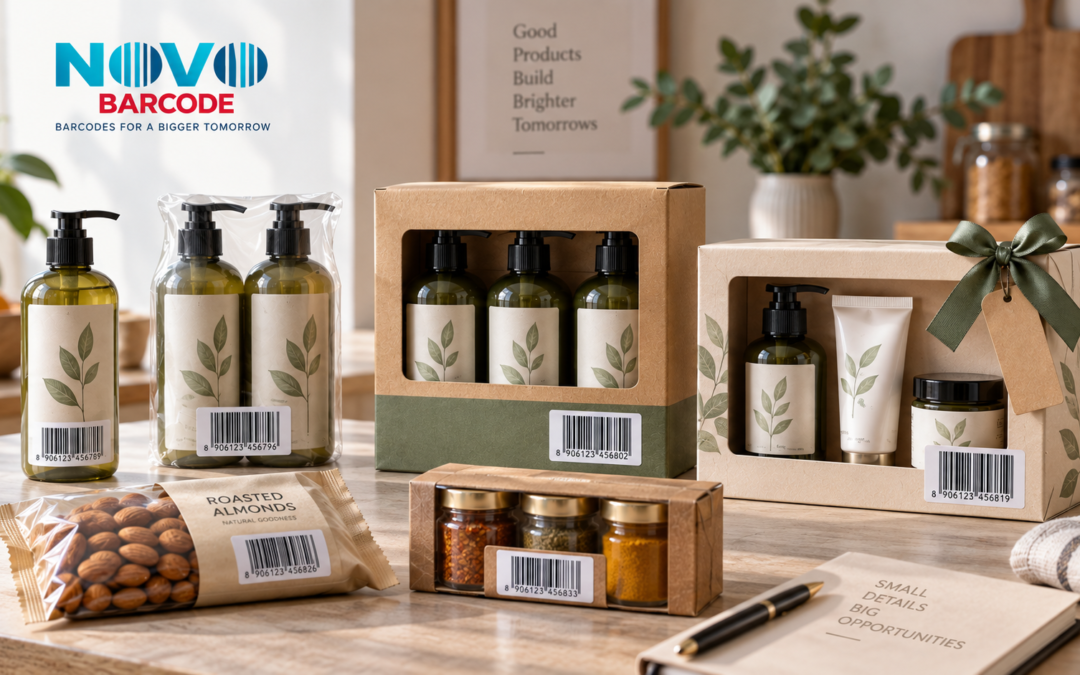
A barcode becomes more complicated when a product is no longer sold only as a single unit. A shampoo that is available as one bottle may later be introduced as a two-pack or three-pack. A skincare brand may sell a face wash and moisturiser separately and then introduce both together as a promotional set. During festive seasons, several existing products may also be placed inside one gift box.
For the customer, these may simply look like different ways of buying the same products. For a business, however, the situation can be quite different. The single bottle, the three-bottle pack and the gift set may be handled as different items when they are priced, ordered, stored or sold.
That is why using the barcode from one product on every type of packaging is not always the right approach.
The real question is simple: what exactly is the package being sold or scanned as? Once that is clear, deciding how the barcode should be handled becomes much easier.
When a Multipack Becomes a Different Product
Imagine a brand selling one bottle of shampoo for ₹299. The same brand introduces a pack of three bottles for ₹799.
The shampoo inside the two packages is the same, but the commercial product is not necessarily the same. The quantity is different, the packaging is different, the selling price is different and the customer is purchasing a different configuration.
The same situation can occur with food packets, cosmetics, stationery, garments, household products and many other categories.
This is why businesses should think about the trade item rather than only the underlying product. A barcode used for the individual unit does not automatically become the identifier for every larger package containing that unit.
If a multipack is created and sold as its own distinct trade item, its identification needs to be considered separately. The individual products inside the pack can still retain their own identifiers.
A Simple Example: One Product, Several Pack Configurations
Consider a food company selling roasted almonds in 200 g packets.
| Pack | Configuration | How It Is Sold |
|---|---|---|
| Single | 1 × 200 g | Individual retail product |
| 2-Pack | 2 × 200 g | Sold together as one pack |
| 5-Pack | 5 × 200 g | Separate multipack |
| 10-Pack | 10 × 200 g | Larger pack configuration |
If all four configurations are separately offered to customers, the business should not assume that the barcode printed on the 200 g packet automatically identifies the larger packs.
The individual packet represents one unit. A five-pack represents five units being offered together as another configuration.
This distinction is particularly important when retailers, warehouses or other systems need to order or scan the complete pack rather than one item from inside it.
What Changes When You Create a Combo?
A multipack normally contains several units of the same product. A combo pack is slightly different because it usually brings different products together.
For example, a skincare company may sell a face wash for ₹299 and a moisturiser for ₹399. Later, it may introduce a “Daily Skin Care Combo” containing both products in one physical box.
The face wash already has its own product identification. The moisturiser has its own as well. But the combined package is now being offered as one physical product configuration.
That is where businesses need to stop thinking only about the products inside the box and start looking at the box itself.
If the combination is created as a distinct trade item and sold as one packaged product, its identification needs to be considered separately from the individual products.
The same principle can apply to shampoo and conditioner sets, toothbrush and toothpaste packs, notebook-and-pen sets and other promotional combinations.
The Products Inside the Pack Do Not Simply Disappear
Creating a multipack does not necessarily mean that the individual products lose their own identification.
Take a three-bottle shampoo pack. Each bottle may already carry the identification used when that bottle is sold individually. The outer three-pack can have identification representing the complete pack.
This allows different packaging levels to be handled separately.
It is particularly useful for businesses that sell products both individually and in larger configurations. The retailer may need to sell one bottle, while the warehouse may receive or move a three-pack.
The packaging should therefore make it clear which barcode represents the item that is intended to be scanned at that level.
Why Putting Several Barcodes on One Pack Can Cause Problems
One common packaging mistake is leaving several product barcodes clearly visible on the outside of a combination pack.
Imagine a gift box containing a face wash, moisturiser and serum. Each product has its own barcode, and all three barcodes remain visible through the outer packaging.
A person scanning the box may not immediately know which barcode represents the complete gift set.
The problem is not that the individual products have barcodes. The problem is that the packaging does not clearly communicate which trade item is supposed to be identified.
For a physical combination pack, businesses should therefore plan the packaging so that the barcode representing the complete pack can be identified correctly.
Gift Packs Need the Same Kind of Planning
Seasonal gift packs are a good example of why barcode planning should happen before packaging is printed.
Suppose a cosmetics company normally sells a lipstick, perfume and moisturiser separately. During Diwali, the company places all three inside a specially designed gift box and sells the box as one product.
Although the contents are existing products, the gift box can represent a different product configuration when it is separately sold and managed.
This becomes especially important when the gift set has its own price, packaging, stock record or ordering arrangement.
The word “gift” or “promotion” does not by itself determine the barcode requirement. What matters is how the resulting package is actually configured and traded.
Physical Bundle and Online Bundle Are Not Always the Same
The word “combo” is also used frequently in e-commerce, but not every online combo is a physical bundle.
For example, an online seller may offer:
“Buy one shampoo and one conditioner together and save ₹100.”
If the seller is simply combining two existing products in an online order without physically creating a new package, the situation can be different from a box containing both products.
A physical bundle and a virtual bundle should therefore not automatically be treated in the same way.
For e-commerce businesses, this distinction is worth checking before ordering additional barcode numbers for every promotional offer they create.
The Outer Carton Is a Different Question
Another area where businesses often become confused is the shipping carton.
A carton containing 24 individual bottles for transportation is not necessarily the same thing as a consumer multipack containing three bottles that is displayed and sold as one retail product.
For example, a manufacturer may have:
| Packaging Level | Example | Typical Purpose |
|---|---|---|
| Consumer unit | 1 × 500 ml bottle | Retail sale |
| Multipack | 3 × 500 ml bottles | Sold as one pack |
| Shipping carton | 12 × 500 ml bottles | Warehouse / distribution |
These three levels may contain the same underlying product, but they serve different purposes in the supply chain.
The barcode strategy should therefore be based on the role of each packaging level rather than simply copying the same barcode onto every carton and package.
EAN-13 is commonly associated with retail point-of-sale applications, while other barcode formats may be used for higher packaging levels and logistics environments depending on the application.
What If the Pack Quantity Changes?
Changing the quantity inside a physical pack can create another product configuration.
For example, a brand might sell:
- Pack of 2
- Pack of 3
- Pack of 4
- Pack of 6
Even though every pack contains the same underlying product, the customer is buying a different quantity and packaging configuration.
If these packs are separately sold or managed, their identification should be considered separately rather than assuming that one barcode will represent every pack size.
This is one reason it is useful to decide your product range before ordering barcode numbers. If you are still working out how many identifiers your products may require, you can also refer to our guide on how many barcodes you need for your products .
What About a “Free” Product Added to the Pack?
Promotional packaging can make the situation slightly less obvious.
Consider a package advertised as:
Shampoo + Free Conditioner
If the conditioner is physically attached to the shampoo and the resulting package is sold as a distinct configuration, the business should evaluate the complete package rather than assuming that the word “free” means the additional product has no identification implications.
The important point is how the resulting item is configured and traded.
Which Barcode Should Be Used?
The barcode symbol should be selected according to where the package will actually be scanned.
For retail products, EAN-13 is commonly used at the point of sale. Higher packaging levels used for distribution may involve other barcode formats depending on the supply-chain requirement.
So when planning a multipack, the better question is not simply: “Which barcode should I put on this box?”
Instead, first establish what the box represents, who will scan it and where that scanning will take place.
A consumer pack moving through a retail checkout and a shipping carton moving through a warehouse do not necessarily have the same identification requirements.
How to Plan Barcodes Before Your Packaging Goes to Print
Barcode planning becomes much easier when the product structure is written down before the designer starts preparing the final artwork.
For every product configuration, note:
- The individual product
- The quantity inside the pack
- Whether the pack is physically combined
- Whether it is sold separately
- Whether it has its own price
- Whether retailers or warehouses order it separately
- Where it will be scanned
- Whether the individual products retain their own barcodes
For a small brand, this might be as simple as a spreadsheet containing the single product, multipacks, combo sets and shipping cases.
For a growing business, doing this exercise before printing packaging can prevent a much bigger problem later. Changing printed packaging after production can be considerably more inconvenient than deciding the barcode structure beforehand.
A Practical Example for a Growing Brand
Consider a personal-care company selling a 500 ml shampoo bottle.
Initially, the company sells only the individual bottle. Later, it introduces a three-pack for customers who want to purchase multiple units together. It then creates a festive gift set containing the shampoo, conditioner and hair mask.
The company now has three different commercial configurations:
- Individual shampoo bottle
- Three-bottle multipack
- Shampoo, conditioner and hair-mask gift set
The fact that all three configurations contain products from the same brand does not mean they should automatically share one barcode.
The business needs to consider how each configuration is sold, ordered, stored and scanned. That decision should be made before the packaging artwork is finalised.
Common Mistakes Businesses Make With Multipack Barcodes
Most barcode problems with multipacks are not caused by the barcode technology itself. They usually begin with product structure.
Using the Barcode of One Product for the Complete Bundle
A barcode identifying one shampoo bottle does not automatically tell a system that three bottles are being sold together as a single pack.
Forgetting the Outer Pack
Businesses sometimes plan identification for individual products but do not consider how the multipack itself will be ordered or scanned.
Leaving Several Barcodes Clearly Visible
When multiple barcodes remain visible on a combination pack, the intended scanning level may become unclear.
Treating Every Carton as a Retail Product
A shipping carton used for warehouse movement is not necessarily the same thing as a consumer multipack. Its identification should be planned according to its actual role.
Ordering Barcode Numbers Too Early
If the business orders barcode numbers before deciding which pack sizes and combinations it will actually sell, it may later discover that its original quantity calculation no longer matches the product range.
Before You Print the Packaging
Before sending a new multipack, combo or gift-set design to the printer, take a few minutes to review the complete product structure.
Ask yourself:
- What exactly is being sold?
- Is the package physically combined?
- Is it sold as one item?
- Does it have its own price?
- Will a retailer or warehouse order it separately?
- Where will it be scanned?
- Which barcode represents the complete package?
- Should the individual product barcodes remain visible?
This small planning exercise can prevent confusion once the products reach retailers, warehouses or customers.
How Many Barcodes Might a Multipack Business Need?
There is no useful answer based simply on how many physical products a company manufactures.
Instead, start with the different trade items the business actually sells or manages.
A company with ten individual products may have considerably more than ten separately managed items once it introduces two-packs, three-packs, gift sets and other physical combinations.
The calculation should therefore reflect the actual product structure rather than simply the number of product names in the catalogue.
For a broader explanation of barcode quantity planning, see: How Many Barcodes Do I Need for My Products?
Conclusions
The easiest way to understand multipack barcodes is to stop looking only at the individual product.
Look at the item that is actually being sold.
One shampoo bottle, a three-bottle multipack and a twelve-bottle shipping carton may contain the same underlying product, but they can have completely different roles in the supply chain. One may be scanned by a customer at retail, another may be sold as a promotional pack, while the third may be used mainly for warehouse and distribution handling.
That is why copying the barcode from the individual product onto every larger package is not always the right solution.
If you are preparing a new multipack, combo or gift set, decide the packaging structure first. Work out which items are sold separately, which configurations are physically combined and where each level will be scanned. Then choose the identification approach that matches the way your business actually operates.
You should also make sure that the final barcode artwork has the correct size and placement for the package. Our guide to EAN-13 barcode size and placement covers the packaging side in more detail.
If you have already finalised your product configurations and require EAN-13 barcode numbers for an intended use where the service is accepted, you can review the available NovoBarcode barcode packages and select the quantity according to your actual requirements.
A good barcode strategy starts before the barcode is printed. Identify the product, understand the pack structure and decide what needs to be scanned. Once those three things are clear, the rest becomes much easier.