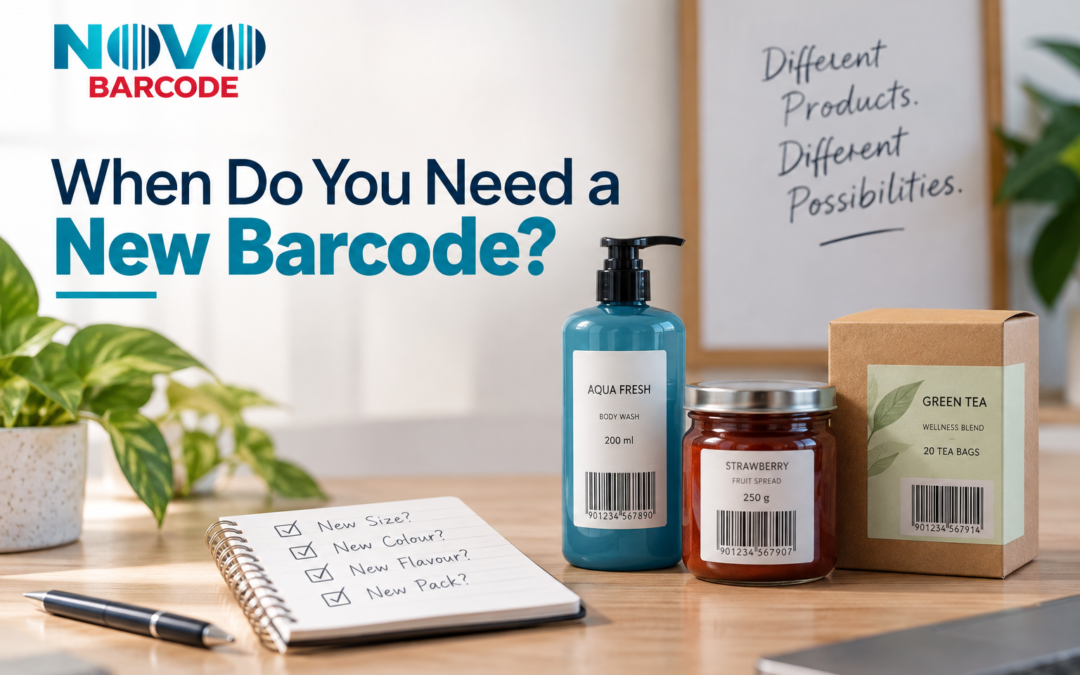
You already have a barcode for your product, your packaging is ready, and then something changes. Maybe you launch a 200 ml version instead of 100 ml, introduce a new flavour, add another colour, create a 5-piece pack, or bring out a new version of an existing product. At that point, one question becomes important: can you keep using the existing barcode, or do you need a new one?
This is a common issue for growing product businesses because a barcode is not simply a graphic that goes on the packaging. It represents product identification. When two sellable products need to be distinguished in a product catalogue, inventory system, retail environment or other sales channel, using the same identifier for both can create confusion.
The situation becomes even more important when a business has several variants under the same brand. A face wash may have three sizes, a shirt may have five sizes and four colours, and a food product may be available in several flavours and pack quantities. Before ordering more barcodes, it is therefore worth understanding which changes actually create a new product variant and which changes may not require a new identifier.
In this guide, we will look at the most common situations Indian manufacturers, private-label brands, wholesalers and online sellers face when deciding whether a new barcode is required.
Quick Answer: When Is a New Barcode Usually Needed?
A new product identifier is generally needed when you introduce a distinct product or product variant that needs to be separately identified in trade.
Common examples include:
- Different product sizes or net quantities
- Different colours where colour represents a separate sellable variant
- Different flavours
- Different product configurations
- Different pack quantities or separately traded multipacks
- New products added to your product range
However, not every packaging or artwork change automatically requires a new barcode. A minor design update is different from a change that creates a materially different trade item. The exact situation should be assessed using the applicable product-identification rules.
Why Does a Product Variant Need a Different Barcode?
The main purpose of product identification is to allow a particular trade item to be distinguished from another one.
Imagine a retailer has two versions of the same shampoo:
- 100 ml Shampoo – ₹199
- 200 ml Shampoo – ₹349
The brand name may be the same and the packaging may look almost identical, but the two products are not interchangeable from an inventory or sales perspective. They have different quantities, different prices and different stock records.
If the same product identifier were used for both, a system receiving the barcode would not have a reliable way to distinguish which version had been scanned.
This is why barcode planning should begin with the question: “How many distinct products or sellable variants do I actually have?” rather than simply asking how many physical packages you want to print.
What Does a Barcode Actually Identify?
It is useful to separate two concepts that are often confused: the product identifier and the barcode symbol.
A product identifier is the number assigned to a particular product or trade item. The barcode symbol is the machine-readable representation printed on the packaging so that a scanner can read that identifier.
EAN-13 is one of the commonly used barcode formats for retail products. The number represented by an EAN-13 symbol should correspond to the particular product it is intended to identify.
This means you should not think of an EAN-13 barcode as a universal label for an entire product range. Your shampoo, conditioner and face wash may all belong to the same brand, but they are different products and need to be identified accordingly.
If you are still deciding how many unique barcode numbers your business needs, our guide on how many barcode numbers you need for your products can help you plan the quantity before ordering.
Do Different Product Sizes Need Different Barcodes?
For separately sold product variants, a change in size or net quantity generally means the variant needs its own product identification.
Consider a skincare company selling the same face wash in three sizes:
| Product | Net Quantity | Separate Variant |
|---|---|---|
| Face Wash | 50 ml | Yes |
| Face Wash | 100 ml | Yes |
| Face Wash | 200 ml | Yes |
Although the product name is the same, each pack represents a different quantity that can be ordered, stocked and sold separately.
The same situation can occur with food, beverages, cosmetics, personal-care products, household goods and many other categories.
Do Different Colours Need Different Barcodes?
Colour becomes important when it represents a separately managed product variant.
Clothing is the easiest example. A T-shirt might be available in black, white, blue and red. If customers can select these colours separately and the business tracks them as separate variants, the product-identification structure needs to distinguish them.
The situation becomes even more complex when size and colour are combined.
For example, a clothing brand might have:
- Small – Black
- Medium – Black
- Large – Black
- Small – White
- Medium – White
- Large – White
That is not simply one product with six packaging designs. It represents six different size-and-colour combinations that may need separate identification.
If you sell clothing products, you can also refer to our detailed guide on barcodes for clothing products in India for additional planning considerations.
Do Different Flavours Need Different Barcodes?
Yes, a flavour change can create a separate product variant when the products are separately sold and identified.
For example, a beverage brand might sell:
- Mango – 500 ml
- Orange – 500 ml
- Apple – 500 ml
The bottle size is identical, but the contents are different. A retailer needs to know which product was sold, and the business needs to keep the corresponding inventory records separate.
The same principle can apply to food products, protein products, cosmetics, personal-care products and other consumer goods where flavour or variant is part of the product identity.
What If the Weight or Net Quantity Changes?
Changing the declared quantity can create a different sellable product.
For example, consider a packaged snack:
- 50 g
- 100 g
- 200 g
- 500 g
If each pack size is sold separately, customers are purchasing different trade items. The business should therefore plan product identification separately for each applicable variant.
This is one reason it is better to prepare your complete product list before buying barcodes rather than purchasing one number and trying to use it across an entire range.
If your business sells packaged food, you can also see our industry-specific guide to barcodes for packaged food products in India .
Does a New Product Always Need a New Barcode?
When a business introduces a genuinely new product, it should not reuse the identifier of an unrelated existing product simply because both products belong to the same brand.
For example, a cosmetics company may already sell:
- Face Wash
- Face Serum
- Moisturiser
If it launches a new sunscreen as a separate product, the sunscreen needs its own product identification rather than borrowing the barcode of the moisturiser.
The brand remains the same, but the products are different.
What If You Only Change the Packaging Design?
This is where businesses often make the wrong assumption.
A new packaging design does not automatically mean a new barcode is required. Suppose you redesign the front of a shampoo box, change the colour of a graphic or update the layout while the actual product and relevant product characteristics remain unchanged.
That situation is different from changing:
- Net quantity
- Product formulation
- Product function
- Product configuration
- Brand or product identity
- Other characteristics that make the trade item materially different
Therefore, do not follow a simplistic rule such as “new packaging means new barcode.” Look at what has actually changed and whether the change creates a new trade item under the applicable identification rules.
Does a New Formula Require a New Barcode?
A formulation change needs more careful consideration than a simple artwork update.
For example, a skincare manufacturer may change the ingredients or formulation of an existing cream. Whether this requires a new product identifier depends on the significance of the change and the applicable identification rules.
If you are using GS1-issued identifiers, follow the current GS1 GTIN Management Rules for your specific situation rather than assuming every formula change is treated in exactly the same way.
This distinction is important because businesses sometimes create unnecessary new barcodes for minor changes while other businesses continue using an old identifier after a significant product change.
Do Multipacks and Combo Packs Need a New Barcode?
This is another common question for growing brands.
Imagine you normally sell one bottle individually but then introduce:
- 1 bottle
- Pack of 2
- Pack of 5
- Pack of 10
If these configurations are separately traded products, the packaging levels may require different product identification.
| Pack Configuration | Example |
|---|---|
| Single | 1 bottle |
| 2-pack | 2 bottles sold together |
| 5-pack | 5 bottles sold together |
| 10-pack | 10 bottles sold together |
The important point is that a multipack is not automatically treated as the same trade item as the individual unit. The identification requirement depends on how that packaging level is traded and managed.
What About Combo or Gift Packs?
Combo packs create a similar situation.
Suppose a skincare brand normally sells:
- Face Wash – 100 ml
- Moisturiser – 50 ml
The company then launches a “Face Care Combo” containing both products in one retail package.
The combo itself may be a separate sellable trade item from the two individual products.
Therefore, businesses creating bundles or gift packs should plan the identification of the bundle separately rather than automatically using one of the component product barcodes.
What About Private-Label Products?
Private-label businesses often face barcode questions when they add products quickly.
For example, a private-label brand may start with:
- 100 ml Shampoo
- 200 ml Shampoo
- 100 ml Conditioner
- 200 ml Conditioner
Even though all four products are manufactured for the same brand, they represent separate product variants.
This is why a private-label business should create its product catalogue first and then calculate the number of unique identifiers required.
For more information on this business model, see our guide to barcode requirements for private-label products .
Can You Reuse an Old Barcode for a New Product?
You should not simply take a barcode assigned to one product and put it on a completely different product.
For example, if barcode A identifies a 100 ml face wash, that identifier should not casually be moved to a new 200 ml serum just because the old product is no longer being sold.
Product identifiers are intended to maintain a consistent connection between the identifier and the product it represents. Reusing an old number without checking the applicable rules can create problems for product databases, retailers and inventory systems.
Can the Same Barcode Be Printed on Thousands of Units?
Yes. A barcode is not normally unique to every physical copy of the same product.
Suppose you manufacture 10,000 units of the same 100 ml shampoo. If those units represent the same product and trade-item configuration, they can carry the same product barcode.
The important distinction is:
Different physical units of the same product can share the same product identifier, while different product variants generally need to be distinguished from one another.
How Many New Barcodes Do You Actually Need?
Before placing a barcode order, create a simple product-and-variant list.
For each product, record:
- Product name
- SKU
- Size
- Net quantity
- Colour
- Flavour
- Pack quantity
- Product configuration
- Current barcode, if any
- Whether the variant is separately sold
For example, a clothing company with 3 sizes and 4 colours should not simply say, “I have one T-shirt, so I need one barcode.” It needs to examine the individual sellable size-and-colour variants.
Once you have this list, calculating your barcode requirement becomes much easier.
For a more detailed explanation of barcode quantity planning, read How Many Barcodes Do I Need for My Products?
What If You Are Selling Through a Marketplace or Retailer?
Your barcode decision should not be made separately from your sales-channel requirements.
A marketplace, retailer, distributor or supply-chain partner may have specific rules about product identifiers, barcode ownership, registration or verification.
For example, a business may have one type of barcode requirement for its own inventory system and a different requirement when a retailer specifically asks for GS1-issued identification.
Before ordering, check the requirements of the channel where the product will actually be sold. This is especially important if you are launching products on multiple platforms.
Do You Need GS1 India Registration?
There is an important distinction between an EAN-13 barcode format and the source of the product identifier.
GS1 India is the authorised GS1 organisation in India for issuing GS1 identification numbers. If a retailer, marketplace or supply-chain partner specifically requires GS1-issued identification, you should follow the applicable GS1 India registration process.
You can check the current requirements directly on the GS1 India barcode registration page .
If your intended use accepts an independent EAN-13 barcode service, check the requirements of that particular sales channel before ordering. Do not assume that every EAN-13 service meets every retailer or marketplace requirement.
When You Should Review Your Barcode Before Printing Packaging
The best time to review barcode requirements is before the packaging artwork goes to print.
Waiting until thousands of boxes, labels or pouches have already been printed can turn a simple barcode decision into an expensive packaging problem.
Before sending artwork to the printer, confirm:
- The exact product name and variant
- Net quantity and pack size
- SKU or internal product code
- Required product identifier
- Barcode format
- Barcode size and placement
- Quiet-zone requirements
- Print quality
- Sales-channel requirements
- Whether the barcode has been tested before mass printing
For the practical side of printing, our guide on EAN-13 barcode size and placement on product packaging covers the packaging considerations that should be checked before final artwork.
Why Barcode Size and Placement Still Matter After You Get the Right Number
Getting the correct product identifier is only the first part of the process. The barcode also has to be reproduced properly on the final packaging.
A barcode that is distorted, printed too small, placed too close to surrounding artwork or produced with poor contrast can create scanning problems even when the underlying number is correct.
That is why barcode planning should continue from product identification to packaging artwork and final print testing.
If you are preparing packaging for a new product, review the EAN-13 size and placement guide before sending the final design to print.
A Simple Example: When One Brand Needs Several Barcodes
Consider a small personal-care brand launching a new shampoo range.
The initial catalogue contains:
- Shampoo 100 ml – Original
- Shampoo 200 ml – Original
- Shampoo 100 ml – Herbal
- Shampoo 200 ml – Herbal
- Shampoo 100 ml – Combo Pack
The company should not automatically treat this as one product simply because every item uses the same brand name and similar packaging.
Each sellable configuration needs to be reviewed individually. Size, formulation and pack configuration may all affect how the products are identified.
This is exactly why barcode planning becomes more important as a business expands its product range.
Common Barcode Mistakes to Avoid
Using One Barcode Across Different Product Variants
A single barcode should not simply be copied across different sizes, flavours or configurations just to save on barcode costs.
Ordering Before Creating a Product List
Without a proper product and variant list, businesses often underestimate or overestimate the number of barcodes they require.
Assuming Every Packaging Change Requires a New Number
A simple artwork update is not automatically the same as creating a new trade item.
Ignoring Multipacks
A bundle or multipack can represent a separate sellable item. Check the identification requirements before printing the same barcode on every packaging level.
Checking Barcode Requirements After Printing
Barcode decisions should be made before mass packaging production, not after thousands of labels or cartons have already been printed.
Assuming Every Barcode Works Everywhere
Different retailers, marketplaces and supply-chain partners can have different requirements. Always check the requirements of the channel where you plan to sell.
Frequently Asked Questions
Do different sizes of the same product need different barcodes?
When the sizes are separately sold product variants, they generally need separate product identification. For example, a 100 ml and 200 ml version would normally be treated as different variants.
Do different colours need different barcodes?
If the colours are separately managed and sold as distinct product variants, they generally need separate identification.
Do different flavours need different barcodes?
A different flavour can represent a different product variant and therefore may require separate product identification.
Does changing the packaging design require a new barcode?
Not automatically. A minor artwork or design change does not necessarily create a new trade item. The significance of the actual product change should be considered.
Does changing the product weight require a new barcode?
When the new weight represents a separately sold product variant, it generally needs separate product identification.
Does a combo pack need its own barcode?
If the combo is separately sold as a distinct trade item, it may require its own product identifier. The exact requirement depends on how the bundle is traded and managed.
Can I use one barcode on thousands of identical products?
Yes. The same product identifier can be used on multiple physical units when those units represent the same product and trade-item configuration.
Can I reuse an old barcode for a new product?
Do not assume that you can simply reassign an old identifier to a different product. Check the applicable identification rules before reusing an identifier.
Do I need a new barcode when I change my formula?
It depends on the nature and significance of the formulation change. Businesses using GS1 identifiers should check the applicable GS1 GTIN Management Rules for the specific situation.
How do I calculate how many barcodes my business needs?
List every product and separately sold variant, including size, colour, flavour, quantity and pack configuration. Then determine which variants require separate identification. You can use our barcode quantity guide as a starting point.
Conclusion: Check the Product First, Then the Barcode
The easiest way to avoid barcode problems is to stop thinking about the barcode as the starting point. The product comes first.
Before ordering a new number, look at exactly what you are selling. Is it the same product with a different design, or has the size, quantity, flavour, colour, formulation or packaging configuration changed? Is the new version being sold separately? Will a retailer or marketplace need to distinguish it from the existing product?
Those questions give you a much clearer picture of whether a new product identifier is needed. They also help you avoid two common mistakes: buying more barcode numbers than necessary and trying to use one identifier across products that should be distinguished.
Once your product and variant list is final, the next step is to confirm the requirements of your intended sales channel and choose the appropriate barcode route. If you are specifically looking for GS1-issued identification, follow the current GS1 India process. If your intended use accepts an independent EAN-13 service, review that provider’s offering and make sure it matches your sales-channel requirements.
If you already know the number of unique EAN-13 barcodes you need and your intended sales channel accepts the service you are considering, you can now review the available NovoBarcode barcode packages and choose a quantity that matches your actual product range.
The goal is not simply to put a barcode on every package. The goal is to make sure each product that needs to be distinguished has the right identification before the packaging goes to print.