For manufacturers, private-label brands, and retailers operating in Kolkata and throughout West Bengal, selecting the right barcode is a critical decision that can influence how smoothly your products enter local shops, supermarkets, and online marketplaces. Understanding the specific barcode requirements of your target sales channels in this region can help you avoid costly delays or rejections at retail points.
While a barcode might seem like a minor packaging detail, choosing an inappropriate type can lead to significant issues. For example, a product barcode might scan correctly internally but be rejected by a retailer. A QR code may direct customers to a product page but fail to meet a marketplace’s product-identification standards. An EAN-13 barcode might work for internal inventory management, but a particular trading partner may require a GS1-issued GTIN for official product identification.
Therefore, instead of asking, “Which barcode is cheapest?” it is more practical to ask, “Where will this product be sold, who will scan it, and what does that sales channel require?”
This guide is designed to help manufacturers, private-label brands, retailers, startups, and online sellers in India make informed decisions before ordering barcode numbers or sending packaging for printing.
Start with the sales channel, not the barcode format
A product often moves through multiple environments: a local shop, a supermarket, a distributor warehouse, Amazon or another marketplace, your own website, and an internal stockroom. Each environment may use product identification differently.
For instance, a small Kolkata-based food brand selling directly through WhatsApp may initially need only an internal SKU and a simple stock record. However, the same brand will likely require a retail barcode when supplying supermarkets. If a marketplace or retail chain has specific barcode policies, those policies should take precedence over the convenience of purchasing any available barcode online.
Before choosing a barcode, list the sales channels you plan to use:
- Direct sales from your own shop, website, or social media
- Local retailers and independent stores
- Supermarkets, organised retail, or distributors
- Online marketplaces
- Warehouse, POS, or inventory software
- Exports or overseas retail customers
Then, consult each key retailer, marketplace, or buyer to confirm their current barcode requirements. Keep in mind that requirements can vary by platform, product category, and seller account. No barcode provider can guarantee acceptance by every third party.
Understand the difference between a barcode, EAN-13, and GTIN
These terms are often used interchangeably but refer to different aspects of product identification.
- Barcode: the machine-readable graphic printed on a label or package.
- EAN-13: a one-dimensional barcode format representing a 13-digit product identifier.
- GTIN: a broader product-identification term; a GTIN-13 can be represented using an EAN-13 symbol.
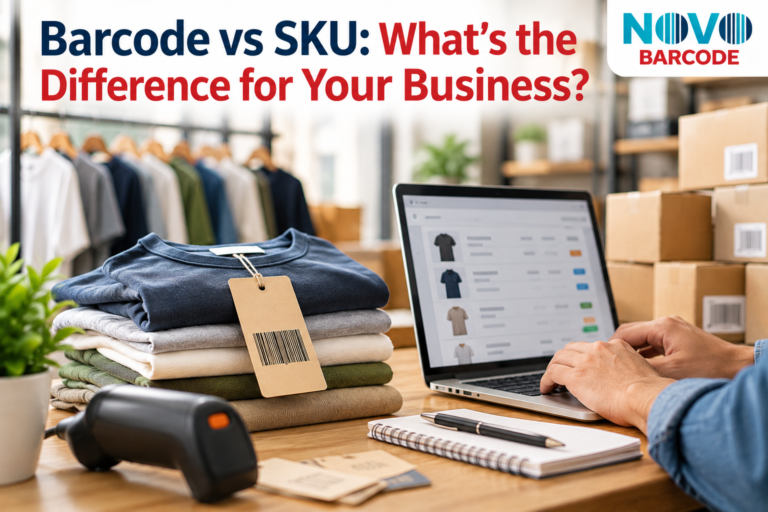
- SKU: an internal stock code created by your business, which is not automatically an EAN-13 or GS1-issued GTIN.
- QR code: a two-dimensional code commonly used to link customers to digital information such as websites, product guides, or instruction pages.
For example, a clothing brand might use TS-BLK-M as an internal SKU for a black, medium T-shirt. The business can also associate an EAN-13 product identifier with this SKU. The SKU helps organise stock internally, while the barcode enables compatible systems to identify the item through scanning.
Keeping these identifiers distinct in your product master sheet helps avoid confusion between internal codes, barcode images, and officially issued product identifiers.
When EAN-13 is the practical choice
EAN-13 is widely used for retail product identification and appears on packaged food, cosmetics, clothing, electronics, household products, and other consumer goods. It is practical when a product requires a standard one-dimensional symbol compatible with scanners, POS systems, or inventory software.
EAN-13 may be appropriate if:
- You are preparing a product label for retail scanning.
- Your inventory or billing software supports EAN-13.
- A distributor or retailer requests an EAN-13-compatible barcode.
- You are launching a small product range needing separate identifiers for sellable variants.
- You want a machine-readable product number alongside your internal SKU.
However, note that “EAN-13” refers to the barcode symbol format and does not by itself indicate who assigned the number or whether it is licensed through GS1. This distinction matters when a retailer, marketplace, or supply-chain partner requires a barcode issued by a specific organisation.
When to consider GS1-issued identification
GS1 and EAN-13 are related but not identical. GS1 provides global identification standards and registration services. An EAN-13 symbol can represent a GTIN, but not every EAN-13 number is a GS1-issued GTIN linked to your company prefix.
Consider obtaining GS1-issued identification if:
- A marketplace, retailer, distributor, or buyer specifically requires a GS1-issued GTIN.
- You want your brand and product information connected to an official GS1 database.
- You supply structured retail or supply-chain partners that mandate GS1 participation.
- You are exporting and the buyer specifies a particular product-identification standard.
If none of your intended sales channels require GS1-issued identification, an independent EAN-13 service might be suitable for product labelling or operational use. However, do not assume that an independently issued number is GS1-licensed, begins with a GS1 India prefix, or will be accepted by every marketplace. For more details, see the complete guide on GS1 barcodes in India.
Making this decision before purchase is important. If a retailer requires GS1-issued GTINs, buying a cheaper independent barcode first may result in additional work later.
Private barcode services: where they may fit
Independent barcode providers can be useful for businesses needing digital barcode numbers and artwork for product labelling, internal inventory, or sales channels that do not require GS1-issued barcodes.
This approach may suit a small manufacturer who:
- Has confirmed that its intended retailer or software accepts the proposed identifier.
- Needs one or a small number of EAN-13 barcodes for a product launch.
- Wants digital files for packaging, labels, or stock management.
- Does not need to register a company prefix through GS1 for the intended use.
- Has verified marketplace and buyer requirements rather than relying on claims of “global acceptance.”
Before ordering, confirm what you will receive: the numeric identifier, barcode artwork, supported file formats, delivery method, invoice details, and any usage restrictions. Also verify whether the service operates independently of GS1. Clear information is more valuable than a low price that does not align with your sales channel. For insights on common pitfalls, see why retailers reject products with barcode problems.
Choose the number of barcodes based on your product structure
The number of barcodes needed depends on distinct sellable products, not just the number of product names in your catalogue.
A practical method is to create one row for every product configuration that may be sold, ordered, stocked, or scanned separately. Include:
- Brand and product name
- Size, weight, volume, or net quantity
- Colour, flavour, shade, or model
- Pack quantity and packaging level
- Internal SKU
- Sales channels
- Barcode or GTIN requirement
For example, a spice brand selling turmeric powder in 100 g, 250 g, and 500 g packs, and chilli powder in the same sizes, has six product configurations to consider, not just two product names.
Similar considerations apply in other categories:
- A T-shirt available in four sizes and three colours may require multiple variants.
- A face serum in 30 ml and 50 ml bottles may need separate product identification.
- A charger with different wattages may be treated as distinct products.
- A two-pack or festive gift set may be a different sellable configuration from individual products.
Do not assign a new barcode for every minor artwork change. Packaging redesigns do not necessarily constitute new products. The key question is whether the product or trade item has changed according to the identification rules and sales-channel requirements that apply to you.
Distinguish between consumer units and shipping cartons
Different packaging levels require separate consideration. A single bottle sold to a consumer, a three-bottle multipack sold as one item, and a carton containing 24 bottles for transport serve different purposes.
The barcode on the consumer unit identifies the item sold at that level. Outer cartons may be handled by warehouses or distributors rather than scanned at retail checkouts, so their identification requirements can differ. Avoid copying the consumer barcode onto every outer package without confirming how each packaging level will be ordered, stored, and scanned.
This is especially important for combo packs and promotional bundles. Even if the package includes “free” items, if the bundle has its own price, stock record, packaging, or ordering arrangement, its identification should be considered separately.
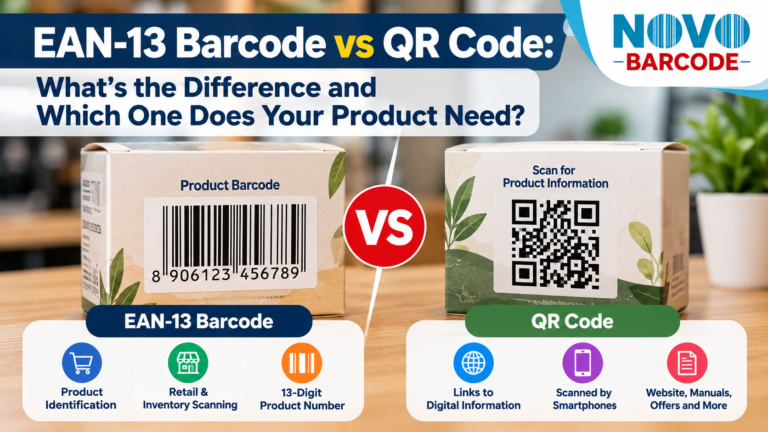
EAN-13 and QR code: often complementary, not interchangeable
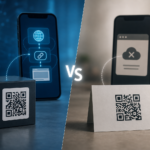
EAN-13 barcodes and QR codes can appear together on the same product because they serve different purposes.
| Question | EAN-13 | QR code |
|---|---|---|
| Primary purpose | Product identification | Digital information or customer interaction |
| Typical destination | POS, inventory, or retail system | Website, instructions, product page, or campaign |
| Common scanning method | Retail or handheld scanner | Mobile phone or QR reader |
| Can it replace the other? | Not normally for digital content | Not automatically for retail identification |
Use EAN-13 when a product requires a retail or inventory identifier. Use a QR code when customers need access to product guides, warranty pages, usage instructions, or other mobile-friendly content. If both are needed, allocate sufficient space and clarify their distinct purposes on the packaging.
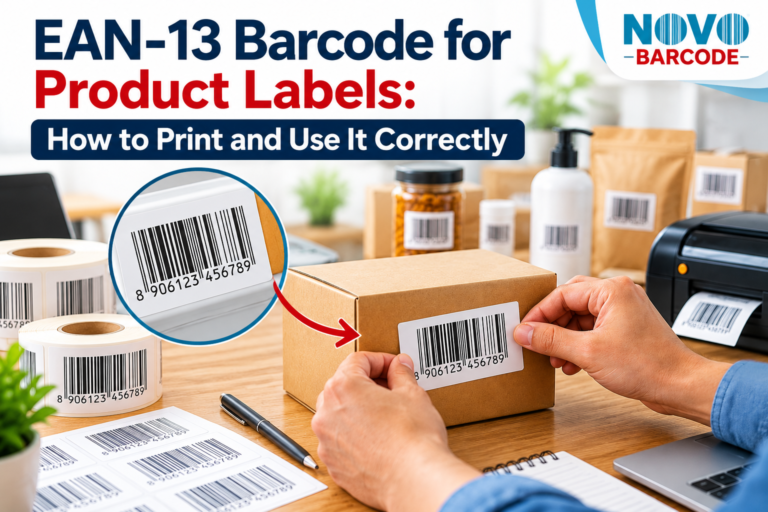
Check the printed barcode before bulk production
Choosing the correct barcode number is only part of the process. The barcode must also be printed to allow reliable scanning.
Before approving a large production run, verify that:
- The barcode corresponds to the correct product and variant.
- The symbol’s proportions are not stretched or compressed.
- The barcode is not reduced in size to accommodate logos or images.
- There is adequate clear space around the barcode.
- The bars and background have strong contrast.
- The barcode is placed away from folds, seams, sharp edges, or heavy curves.
- Glossy, metallic, or textured packaging has been physically tested for scanability.
- The numbers beneath the barcode match the intended identifier.
- A production-quality sample scans successfully with the equipment used by the relevant retailer or warehouse.
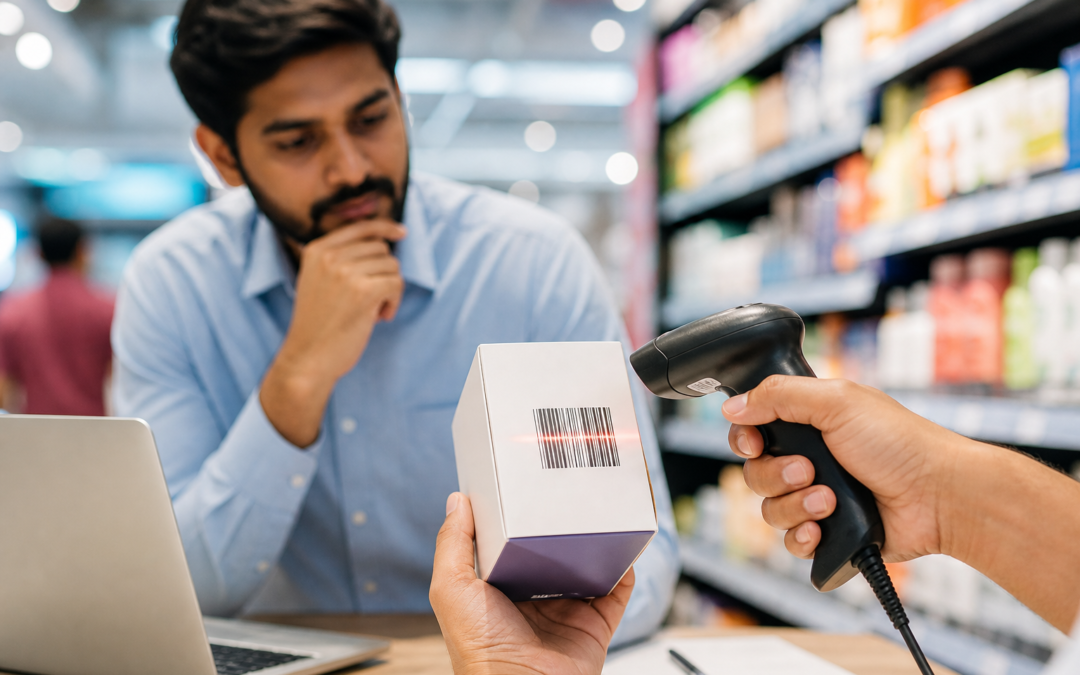
While a phone scan is a useful preliminary check, it does not guarantee that the barcode will work with all scanners or that the product has been registered in a retailer’s database. Successful scanning and retail acceptance are distinct outcomes.
A simple barcode decision framework
- List your sales channels. Document every retailer, marketplace, distributor, and internal system involved.
- Request written requirements. Confirm whether each channel requires EAN-13, a GTIN, GS1-issued identification, or another format.
- Map your product range. Include sizes, colours, flavours, quantities, multipacks, and gift sets.
- Choose the identifier source. Opt for GS1-issued barcodes when specifically required; consider independent providers only when appropriate for your use case.
- Create a product master sheet. Keep SKUs, product details, identifiers, and barcode artwork together.
- Reserve packaging space. Ensure designers allocate sufficient area for barcodes before finalising artwork.
- Test a physical sample. Verify the barcode number, print quality, and scan success before approving bulk printing.
Frequently asked questions
Is EAN-13 sufficient for every product sold in India?
Not necessarily. While EAN-13 is a widely used format, the appropriate identifier depends on the retailer, marketplace, product system, and intended use. Some sales channels may require GS1-issued identification.
Does buying an EAN-13 barcode mean I have a GS1 barcode?
No. The EAN-13 format and the source of the underlying number are separate. An independently supplied EAN-13 number should not be described as GS1-issued unless it has been issued through the official GS1 process.
Can I use my SKU as the barcode?
An SKU is an internal stock code. It can be stored alongside a barcode but is not automatically a valid EAN-13 or GTIN.
Should I use a QR code instead of EAN-13?
Use a QR code for digital content and customer interaction. Use EAN-13 when a retail or inventory system requires a compatible product identifier. Some products benefit from having both.
Does a barcode guarantee marketplace acceptance?
No. Marketplace policies, category rules, and seller requirements can change. Always check the current requirements of each platform before purchasing or printing identifiers.
Conclusion
Choosing the right barcode for products sold in Kolkata, West Bengal, and across India depends largely on the specific sales channels and their requirements. While EAN-13 is a practical and widely used format for retail and inventory scanning, it is important to verify whether the barcode number is GS1-issued or accepted by your target marketplaces and retailers.
If a retailer or platform requires a GS1-issued GTIN, following that requirement can help facilitate smoother acceptance. Conversely, if your sales channels accept independently issued EAN-13 barcodes, this option may be suitable for product labelling and inventory management. In all cases, maintaining clear organisation of your product structure, SKU records, and barcode assignments is essential to avoid confusion and delays.
To proceed confidently, prepare a detailed product master sheet and engage with each key sales channel to confirm their specific identifier requirements. Carefully count your sellable variants, allocate adequate barcode space in your packaging design, and test a physical barcode sample before approving bulk printing. This careful, channel-focused approach can help you reduce the risk of costly mistakes and support smoother product acceptance in Kolkata’s diverse retail landscape and beyond.
Continue Reading: EAN-13 Guides
Explore practical guides for product identification, packaging and retail preparation.
 Why Your EAN-13 Barcode Scans but the Product Does Not Appear at Billing
Read guide →
 EAN-13 Barcode vs QR Code: What’s the Difference and Which One Does Your Product Need?
Read guide →
 Barcode for Product Labels: How to Print and Use It Correctly
Read guide →
 Barcode vs SKU: What’s the Difference for Your Business?
Read guide →