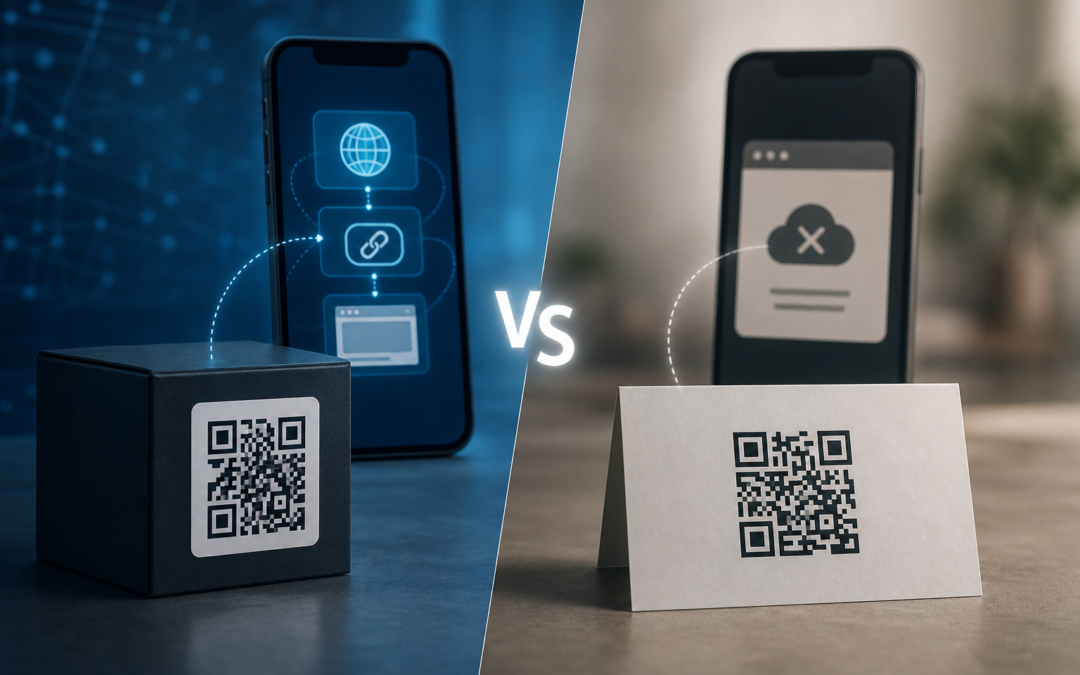
If you run a business in Kolkata or elsewhere in West Bengal and are planning to use QR codes on printed materials such as menus, product packaging, or promotional flyers, understanding the practical differences between static and dynamic QR codes can help you select the most suitable option for your local market and operational needs.
For instance, a Kolkata restaurant might print QR codes on table cards linking to its menu, a manufacturer could add QR codes to product labels directing customers to instruction pages, and a retailer might include QR codes on festival flyers distributed across multiple cities in West Bengal.
While all these QR codes may scan correctly when printed, challenges arise when menus change, webpages move, offers expire, or printed materials are already in customers’ hands. This is where the distinction between static and dynamic QR codes becomes important.
A static QR code contains the destination information directly within the code itself, whereas a dynamic QR code points to a managed link that can be updated later without changing the printed code. Neither option is inherently better; the right choice depends on factors such as the expected lifespan of your printed materials, the likelihood of destination changes, your need for scan analytics, and your willingness to rely on a QR code management platform.
Static and dynamic QR codes: the short answer
Choose a static QR code when your destination is unlikely to change, your printed material has a short or fixed lifespan, and you prefer a code that does not depend on ongoing service management.
Choose a dynamic QR code when your printed code will be used over a longer period, the destination may need updating, or you want to manage multiple codes and track scan activity.
Note that a static QR code can sometimes be paired with a URL on your own website that uses redirects, allowing you to change the destination without altering the QR code itself. This flexibility comes from your website infrastructure rather than the static QR code. Dynamic QR code services typically include this redirect functionality as part of their platform.
What is a static QR code?
A static QR code encodes the destination information directly into the printed pattern. For example, a Kolkata sweet shop might generate a static QR code linking to its fixed website address. Small businesses might also use static codes for WhatsApp chat links, email addresses, Wi-Fi connections, or one-time event registrations.
The main advantage of static QR codes is their simplicity. Once created, they generally do not require subscriptions or dashboards to function and will continue to work as long as the encoded destination remains accessible and the printed code is intact.
Where static QR codes are usually suitable
- Short-term flyers and posters
- One-time event invitations
- Fixed contact cards or email addresses
- Simple business cards
- Permanent links fully controlled by the business
- Internal labels where scan tracking is unnecessary
Static codes are not inherently “basic.” For stable destinations, they can be a cleaner, lower-maintenance choice.
What is a dynamic QR code?
A dynamic QR code contains a managed or redirecting link rather than the final destination URL. When scanned, it directs the user to a managed link that can be updated to point to different destinations over time.
For example, a manufacturer printing QR codes on product packaging can update the linked product guide or warranty page without changing the printed packaging, provided the dynamic QR service remains active.
This flexibility is especially valuable for packaging, menus, brochures, signage, and other printed materials that are costly or difficult to replace.
Benefits of dynamic QR codes
- Editable destinations: Update the linked webpage, menu, or campaign without reprinting.
- Central management: Manage multiple QR codes from a single dashboard.
- Scan analytics: Access reports on scan activity, useful for operational insights (though these should be interpreted cautiously).
- Pause or status controls: Temporarily disable or reactivate codes without replacing printed materials.
- Print-ready downloads: Obtain formats like PNG or SVG suitable for various printing needs.
However, dynamic QR codes depend on the ongoing availability of the redirect service and account management. If the service lapses or the account is not maintained, the printed code may fail to deliver the intended experience.
Dynamic QR code vs static QR code: practical comparison
| Consideration | Static QR code | Dynamic QR code |
|---|---|---|
| Can the destination be changed from a dashboard? | Usually no | Yes, while the service is active |
| Does the printed QR pattern need to change after a destination update? | Usually yes, unless your website manages redirects | No |
| Ongoing service dependency | Low, if destination remains accessible | High, requires active redirect service |
| Scan reporting | Not built-in | Available via provider platform |
| Best for | Fixed, simple, or short-term destinations | Long-life print and changing information |
| Operational complexity | Low | Requires account and destination management |
Note that features, data retention, and reporting vary by provider. Always review current terms before printing large quantities.
When should a business choose a static QR code?
Static QR codes are generally appropriate when the destination is stable and the printed material has a limited lifespan.
1. The destination is genuinely permanent
If your QR code links to a fixed contact page, a stable homepage, or a document you control and expect to maintain, the added complexity of dynamic editing may not be necessary.
2. The material will be used briefly
For short campaigns, event notices, or limited-time offers, a static QR code is often sufficient if the destination will not change during the campaign.
3. You do not require scan reporting
If the QR code is primarily for customer convenience, such as opening a fixed contact page, scan analytics may not add value.
4. You prefer fewer moving parts
Static codes simplify documentation and maintenance, with no need to monitor or renew a QR management account.
When is a dynamic QR code the better choice?
Dynamic QR codes are advantageous when printed materials are expected to remain in use beyond the initial destination’s validity.
1. Product packaging remains in circulation
For example, a packaged food brand in West Bengal printing QR codes on spice pouches may want to update preparation suggestions, recipes, or customer support pages over time without reprinting packaging.
2. Menus or ordering pages change frequently
A Kolkata café updating seasonal menus or delivery partner information can benefit from dynamic QR codes on durable table signage.
3. Campaigns with multiple stages
Dynamic codes allow a single printed banner to link to registration, event details, and follow-up pages sequentially without replacement.
4. Managing multiple codes
Businesses with numerous QR codes across products or locations can centralize management and reduce tracking errors.
5. Need for scan information
Scan analytics can provide operational insights, though data should be interpreted carefully and not assumed to represent unique customers or sales.
Cost considerations: look beyond generation price
Static QR codes typically involve a one-time generation cost, while dynamic QR codes often require ongoing platform fees. However, total cost should also consider design, printing, potential reprinting, management time, and risks of broken links.
For small, short-lived print runs, static codes may be more economical. For large quantities or long-term use where destinations may change, dynamic codes can reduce reprinting costs and customer confusion.
Evaluate renewal fees and service reliability carefully before committing to dynamic QR codes, and consider the potential disruption of reprinting static codes if destinations change.
Important risks and limitations
Dynamic codes depend on the redirect service
Dynamic QR codes require an active service account. If the service ends, the account is not renewed, or the destination is misconfigured, the printed code may fail. Verify plan durations, renewal policies, and data export options before selecting a provider.
Changing the destination does not fix poor webpage design
Ensure the linked page is mobile-friendly, loads quickly, and provides a clear user experience under typical network conditions in Kolkata and West Bengal.
Analytics require careful interpretation
Scan counts may include repeat scans, staff tests, or automated requests. Use analytics as directional insights rather than definitive measures of customer engagement.
QR codes do not replace product barcodes
QR codes connect users to digital content, while EAN-13 barcodes are essential for product identification in retail and inventory systems. Products may carry both codes serving different purposes. For more on product barcodes, see the complete guide to EAN-13 barcodes.
Security and trust remain important
Customers may hesitate to scan unfamiliar codes. Use clear instructions, link to trustworthy pages, and avoid complicated redirect chains. Regularly review destinations, especially for long-life products or public signage.
How to choose the right type: a decision test
Before generating QR code artwork, consider these questions:
- Will the printed material last longer than the current webpage or offer? If yes, dynamic QR codes may be beneficial.
- Is the destination fixed and controlled by your own website? If yes, static codes may suffice, especially if your website manages redirects.
- Will the code appear on packaging, signage, or materials costly to replace? If yes, dynamic codes can reduce reprinting needs.
- Do you need scan reporting for business decisions? If no, simpler static codes may be preferable.
- Can your team maintain an active account and review destinations? If no, dynamic codes may introduce avoidable risks.
- Does your retailer or sales channel require an EAN-13 barcode? If yes, plan that separately; QR codes do not replace barcodes.
A practical rule: use static QR codes for stability; use dynamic QR codes when you anticipate changes. The longer the print lifespan and the more uncertain the destination, the stronger the case for dynamic management.
Printing and testing checks for either option
Regardless of QR code type, successful scanning depends on proper printing and testing:
- Ensure strong contrast between the QR code and background.
- Maintain a clear margin around the code.
- Avoid placing text, logos, or decorations too close to edges.
- Do not reduce the code size below scan-friendly dimensions.
- Test printed samples under typical lighting and with multiple mobile devices.
- Test on actual packaging materials, including glossy or curved surfaces.
- Confirm the destination loads correctly on mobile devices.
- For dynamic codes, verify account status and destination activity before mass printing.
- Document code name, destination, print location, and responsible person in a master record.
Vector formats like SVG are useful for scaling dynamic QR codes on packaging or signage, while PNG may suit other workflows. For detailed instructions, see the Dynamic QR Code User Guide & Business Benefits.
A practical setup for product businesses
Consider a packaged-food brand in West Bengal printing a QR code on spice pouches. The brand wants customers to access preparation suggestions initially but may later add recipes, language options, or customer support pages.
A practical approach would be:
- Determine whether the QR code is for customer information, product identification, or both. If retail identification is needed, plan for an EAN-13 barcode separately.
- Create a mobile-friendly destination on the brand’s website.
- Choose a static QR code if the brand controls a permanent URL and can manage redirects.
- Choose a dynamic QR code if the packaging will remain in circulation and the team wants to update destinations or access scan reports via a dashboard.
- Print and test a production-quality sample.
- Record the code and destination in a product master sheet.
- Review the destination after launch and before updating any campaign or product information.
This approach aligns the QR code choice with business needs rather than assumptions about technology trends.
Conclusion
For businesses in Kolkata and across West Bengal, choosing between static and dynamic QR codes depends on your printed materials’ expected lifespan, the likelihood of destination changes, and your capacity to manage the codes effectively. Static QR codes can provide a straightforward, low-maintenance solution for stable, short-term uses. Dynamic QR codes offer flexibility and management features that may be valuable when your digital content or campaigns evolve over time.
Ultimately, maintaining control over the customer journey after printing is essential. If you select dynamic QR codes, carefully assess the provider’s plan duration, renewal policies, reporting capabilities, and contingency options if service access ends. If you opt for static codes, use destination URLs you can maintain and consider hosting them on websites that support redirects.
Before generating your QR code, document the destination, expected print lifespan, likelihood of change, reporting needs, and the responsible team member. Test printed samples on multiple devices to ensure a smooth customer experience. This practical, informed approach will help you select the QR code type that best supports your business goals and customer engagement in the local market.
Continue Reading: EAN-13 Guides
Explore practical guides for product identification, packaging and retail preparation.
 Why Your EAN-13 Barcode Scans but the Product Does Not Appear at Billing
Read guide →
 EAN-13 Barcode vs QR Code: What’s the Difference and Which One Does Your Product Need?
Read guide →
 Barcode for Product Labels: How to Print and Use It Correctly
Read guide →
 Barcode vs SKU: What’s the Difference for Your Business?
Read guide →