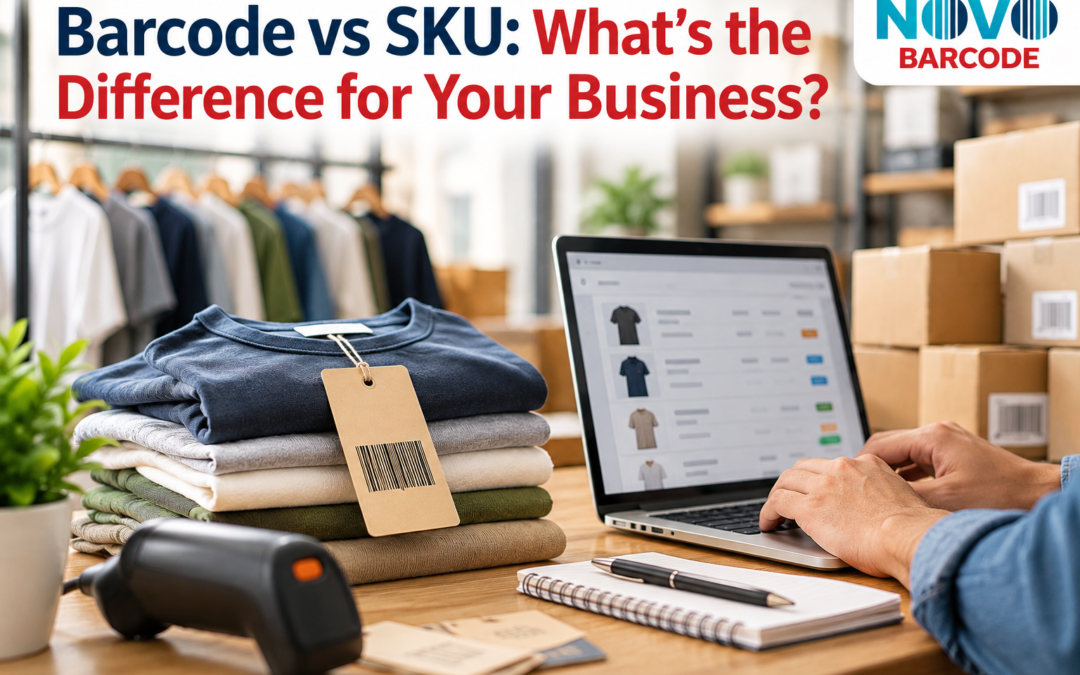
If you sell products online, supply retailers, manage stock in a warehouse, or are preparing your products for organised retail, you will eventually come across two terms: barcode and SKU.
They are often used together, but they are not the same thing. A business can have an SKU for a product without having a barcode, and a product can have a barcode while the business uses a completely different internal SKU system.
This distinction becomes important when your product range starts growing. What works when you have 10 products can become difficult to manage when you have 100, 500 or several thousand product variations. A clothing business, for example, may have one product design with several colours and sizes. The business needs a way to identify those variations internally, while retailers and scanning systems may need a standard product identifier.
So, what is the difference between a barcode and an SKU? More importantly, should your business use one or both?
This guide explains the difference in practical terms, with examples for Indian manufacturers, D2C brands, retailers, wholesalers and online sellers.
What Is an SKU?
SKU stands for Stock Keeping Unit. It is an internal identification code that a business creates for its own products or product variations.
Unlike a standard retail identifier, an SKU does not have to follow one universal numbering system. A company can create its own format depending on how it manages inventory.
For example, imagine a clothing company sells a black cotton T-shirt in three sizes:
- TS-BLK-S
- TS-BLK-M
- TS-BLK-L
These could be three different SKUs in the company’s inventory system.
The business decides what the codes mean. It might use letters for the product category, colour and size, or it may simply use a sequential numbering system such as SKU1001, SKU1002 and SKU1003.
The important point is that an SKU is primarily designed for the business’s own inventory management.
What Is a Barcode?
A barcode is a machine-readable representation of product identification data. Instead of asking a staff member to type a product number manually, a compatible scanner can read the barcode and allow the connected system to identify the product.
One of the barcode formats commonly associated with retail products is EAN-13. It contains 13 digits and is widely used in retail environments where EAN-13 is supported.
However, it is important not to confuse the barcode image with the underlying product number. The black-and-white bars are the visual, machine-readable representation. The number printed below the bars is the human-readable part.
If you are still learning how EAN-13 works, our detailed guide explains the structure and scanning process: how EAN-13 barcodes work.
Barcode vs SKU: The Main Difference
The easiest way to understand the barcode and SKU difference is to look at who controls the identification system and what the identifier is intended to do.
| Feature | SKU | Barcode |
|---|---|---|
| Main purpose | Internal inventory identification | Machine-readable product identification |
| Created by | Usually the business | Depends on the barcode/product identification system |
| Universal? | No | Certain barcode/product identification standards are designed for broader use |
| Used for inventory? | Yes | Yes, when integrated with inventory/POS systems |
| Can it be scanned? | Not necessarily | Yes, when represented in a compatible barcode format |
Why Do Businesses Use SKUs?
SKUs become particularly useful when a business has many products or product variations.
Consider a small apparel brand selling 20 designs. Each design is available in five sizes and four colours. The business is no longer dealing with only 20 products. From an inventory perspective, there may be hundreds of individual variations.
An internal SKU structure can make these variations easier to identify.
For example:
- SH-BLU-M – Blue shirt, Medium
- SH-BLU-L – Blue shirt, Large
- SH-WHT-M – White shirt, Medium
- SH-WHT-L – White shirt, Large
The exact naming system is up to the company. The goal is simply to make stock management easier.
This is why an SKU can be extremely valuable even when a product does not yet have a barcode.
Why Do Businesses Use Barcodes?
Barcodes solve a different problem.
Instead of manually entering a product identifier into a computer system, a compatible scanner can read the barcode. This can reduce manual data entry and make repetitive operations such as billing, stock receiving and product identification more efficient.
For a business selling through physical retail, the requirement for a barcode may also come from the retailer, distributor, marketplace or operational system involved in selling the product.
This is why businesses should not assume that having an internal SKU automatically means they have everything required for retail selling.
If you are a small business starting to use product identification, our guide to barcodes for small businesses in India provides a more practical starting point.
Can a Business Have Both an SKU and a Barcode?
Yes. In fact, using both can be a sensible approach for many growing businesses.
Think of them as two different layers of product management.
Your SKU helps your business understand the product internally.
Your barcode allows compatible external or internal systems to identify the product through scanning.
For example, a business might store the following information:
| Product | Men’s Cotton T-Shirt |
| SKU | TS-BLK-M |
| EAN-13 | Product’s assigned EAN-13 number |
| Colour | Black |
| Size | Medium |
The inventory system can use the SKU for internal organisation while storing the barcode number as another product field.
Is an SKU the Same as an EAN-13 Barcode?
No. This is one of the most common points of confusion.
An SKU is normally a business-created inventory identifier. EAN-13 is a specific barcode format used to represent a 13-digit product identification number in a machine-readable form.
Therefore, you should not simply take your internal SKU and assume that it can be used as an EAN-13 product number.
For example, an SKU such as:
TS-BLK-M
is useful to your business, but it is not a 13-digit EAN-13 number.
If you want to understand the practical requirements around EAN-13 barcode size and placement on packaging, make sure the barcode is generated and printed in a way that allows reliable scanning.
What Happens When a Product Changes?
This is another area where the difference between SKU and barcode becomes important.
A business may change its internal SKU structure at any time for organisational reasons. However, product identification requirements should be considered separately.
A change that creates a genuinely different product or product variation may require a different product identifier depending on the applicable identification system and the requirements of the retailer or marketplace.
For example, changing the colour or size of a clothing product may result in separate inventory items and separate identifiers in a retail system.
This is why businesses should plan product identification before printing thousands of labels or packaging materials.
Barcode vs SKU for Ecommerce Businesses
Online sellers often use both.
An ecommerce platform may have its own product ID, SKU field, inventory ID and barcode/GTIN field. These fields should not automatically be treated as interchangeable.
For a growing ecommerce business, keeping a clean product database can prevent problems later.
A simple product record could include:
- Product name
- Internal SKU
- Barcode number
- Product category
- Brand
- Variant
- Size
- Colour
- Selling price
- Inventory quantity
This becomes particularly important when products are sold through multiple channels.
If you are planning to sell on marketplaces, retailers and your own website, you should also understand the requirements before purchasing or printing product identifiers. Our guide on barcodes for Amazon and Flipkart in India covers this issue from an ecommerce perspective.
What About GTIN, UPC and EAN?
Another reason businesses get confused is that the terms SKU, barcode, GTIN, UPC and EAN are sometimes used as though they mean the same thing.
They do not.
An SKU is generally an internal stock code.
EAN-13 refers to a barcode format commonly used to represent a 13-digit product identifier.
GTIN is a broader family of globally recognised trade item identifiers, with different formats used in different situations.
UPC is another product identification format commonly associated with retail, particularly in North America.
The exact identifier required depends on where and how the product will be sold. If a particular retailer, marketplace or trading partner specifies a particular identification standard or issuing organisation, follow that requirement rather than assuming any barcode will be accepted.
Do I Need a Barcode If I Already Have an SKU?
Having an SKU does not automatically remove the need for a barcode.
The answer depends on your sales and operational requirements.
If you sell a small number of products directly through your own website and only need an internal inventory system, an SKU may be sufficient for your internal needs.
If your products are entering physical retail, distribution networks, warehouse systems or sales channels that require machine-readable product identification, a barcode may become necessary.
For businesses preparing products for retail, it is also useful to understand common barcode problems that can lead to retail scanning issues.
How Many Barcodes Does a Business Need?
The answer depends on how many distinct products and product variations you are managing.
You should not simply count the number of product names on your website.
For example, if you sell:
- 1 shirt design
- 3 colours
- 4 sizes
you may have 12 individual variants from an inventory perspective.
Whether each variant requires a separate product identifier depends on how those products are identified and sold.
Before ordering identifiers, it is worth planning your product catalogue carefully. Our detailed guide explains how many barcodes you may need for your products.
A Simple Example: A Small Clothing Brand
Suppose a Kolkata-based clothing brand launches one cotton T-shirt.
The company internally calls it:
TS-BLK-M
That is its SKU.
The company may use this code in its inventory software to quickly understand that it refers to a particular T-shirt, colour and size.
The product may also have an EAN-13 barcode printed on its packaging or hang tag where appropriate.
When an employee searches inventory, the SKU can be useful. When a compatible scanner needs to identify the product, the barcode can be useful.
There is no need to force one system to do the job of the other.
Common Mistakes Businesses Make
1. Treating SKU and barcode as the same thing
They have different purposes. Keeping separate fields for SKU and barcode in your product database is usually much cleaner.
2. Assuming any number can become a retail barcode
An internal inventory code does not automatically become a valid product identifier simply because it is converted into a barcode image.
3. Creating product identifiers at the last minute
If packaging, labels, cartons and product listings are already being produced, changing identifiers later can create unnecessary work.
4. Ignoring product variations
Size, colour, pack quantity and other meaningful variations need to be considered when designing your product identification structure.
5. Printing a barcode without testing it
A barcode that looks correct to the human eye can still create scanning problems because of size, contrast, placement, print quality or surrounding design.
If you already have a barcode and want to check whether its number and format are being handled correctly, you can also read our guide on how to verify an EAN-13 barcode.
How Should You Set Up SKU and Barcode Information?
A practical approach is to treat them as separate pieces of information inside your product database.
For example:
| Database Field | Example |
|---|---|
| Product Name | Men’s Cotton T-Shirt |
| SKU | TS-BLK-M |
| Barcode | Assigned product barcode number |
| Variant | Black / Medium |
| Stock | 125 units |
This simple separation becomes increasingly useful as your business expands into multiple sales channels.
Which One Should Your Business Use?
For most growing product businesses, the answer is not really SKU or barcode.
It is often SKU and barcode.
Use an SKU to organise your products internally. Use the appropriate barcode/product identification system when your sales channel, retailer, warehouse or operational process requires machine-readable identification.
If you manufacture or sell packaged products, the requirements may also vary by category. For example, businesses selling food products can review our guide to barcodes for packaged food products in India, while cosmetic brands can explore our guide to barcodes for cosmetic products.
Need Barcodes for Your Products?
If you have already decided which products need identification, the next step is to plan the number of identifiers required, the product variants involved and where the barcode will appear on your packaging.
You can review the available barcode packages or first understand the process through our barcode and product registration guide for Indian businesses.
Taking this step before printing packaging can save time and prevent avoidable changes later.
Frequently Asked Questions
Is SKU the same as a barcode?
No. An SKU is generally an internal inventory code created by a business. A barcode is a machine-readable representation used to identify products through compatible scanning systems.
Can I use my SKU as my barcode?
Not automatically. An SKU and a product barcode serve different purposes. Your internal SKU should not simply be treated as an EAN-13 product identifier.
Can one product have both an SKU and a barcode?
Yes. This is common. The SKU can be used internally for inventory management while the barcode can be used for scanning and product identification where required.
Do all products need a barcode?
Not necessarily. The requirement depends on how and where the product is sold and the systems used by the business, retailer, marketplace or other trading partner.
Does every product variation need a different barcode?
Product variations need to be assessed individually. Size, colour, pack quantity and other changes can affect how products are identified in a particular sales or inventory system.
Is EAN-13 the same as GTIN?
They are related but should not be treated as identical terms. GTIN is a broader product identification concept, while EAN-13 refers to a specific 13-digit barcode format.
Conclusion: Think of SKU and Barcode as Two Different Tools
The easiest way to remember the barcode vs SKU difference is this: your SKU is primarily about how your business organises its products, while a barcode is about allowing compatible systems to identify a product through scanning.
A growing business does not have to choose one and ignore the other. In many cases, the strongest product-management setup is to maintain a clear internal SKU structure while also using the appropriate product barcode where the sales channel or operational requirement calls for it.
This becomes even more important when a business moves from a small product catalogue to multiple variants, online marketplaces, distributors, retail stores and larger inventory operations.
Before printing labels or packaging, take a few minutes to map your products, variants, SKUs and required product identifiers. It is much easier to establish the structure correctly at the beginning than to change thousands of labels later.
If you are still deciding what type or quantity of barcode your business needs, start with your product catalogue and sales channels rather than simply asking, “Which barcode should I buy?” That small change in approach can prevent many product-identification problems as your business grows.
A barcode and an SKU are not competitors. They solve different problems—and understanding that difference is the first step toward better product and inventory management.
Continue Reading: EAN-13 Guides
Explore practical guides for product identification, packaging and retail preparation.
 Why Retailers Reject Products With Barcode Problems | India Guide
Read guide →
 Barcode for Multipack Products in India: Do You Need a New One?
Read guide →
 Why Is My Barcode Not Scanning? 11 Common EAN-13 Problems & Solutions
Read guide →
 When Do You Need a New Barcode? Product Variant Guide for India 2026-2027
Read guide →