If you’re planning to launch a new product in India, one question will almost certainly come up:
“Do I really need a GS1 barcode to sell my products?”
Whether you’re selling spices, cosmetics, clothing, health supplements, handmade products, packaged foods, or household goods, understanding barcode requirements is essential before printing labels and shipping products.
Many entrepreneurs believe every product sold in India must have an official GS1 barcode. Others think any barcode will work everywhere. The truth lies somewhere in between.
The right barcode solution depends on how you plan to sell your products, your target customers, your inventory system, and your future business goals.
In this guide, we’ll explain what GS1 barcodes are, when they may be required, when other barcode solutions may be suitable, and how proper barcode planning can help your business grow.
Why Barcodes Matter for Every Business
Regardless of whether you’re a startup or an established manufacturer, every product business eventually faces the same challenge—inventory management.
As your product range grows, manually tracking stock becomes difficult.
Imagine you sell:
- 10 spice products
- 5 skincare products
- 3 candle fragrances
- Multiple sizes of each product
Very quickly, your inventory becomes difficult to manage without a proper identification system.
A barcode gives every product its own identity.
Instead of searching product names manually, barcode scanners can instantly recognize products, helping improve inventory management and reducing human error.
What Is a GS1 Barcode?
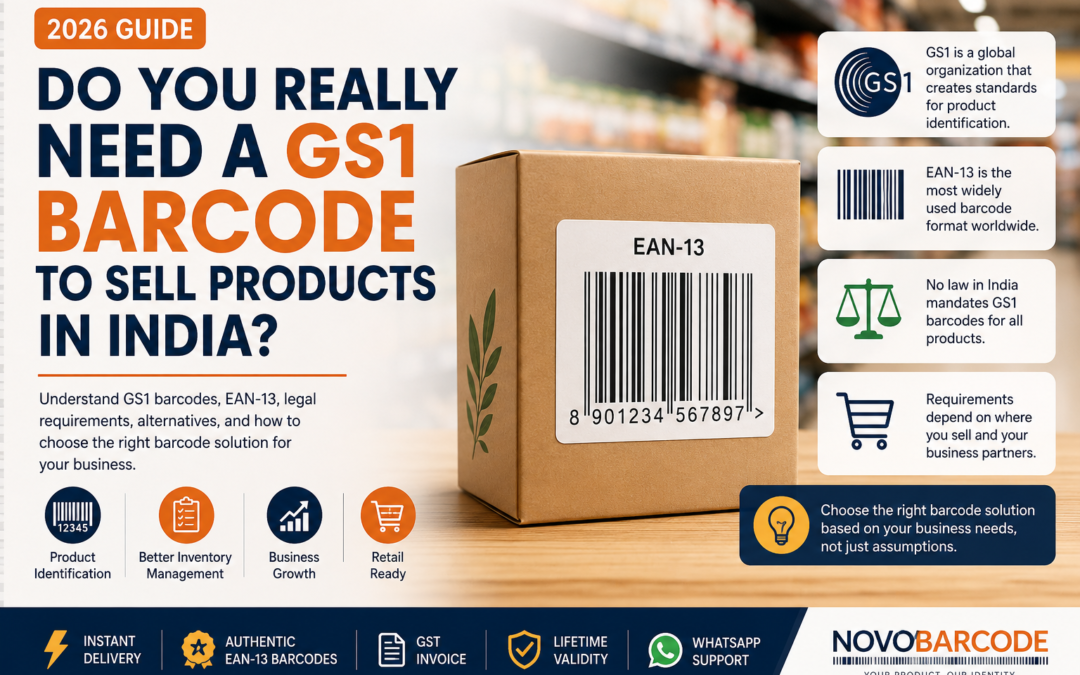
GS1 is a global organization that develops standards for product identification and supply chain management.
Businesses obtain identifiers through GS1 membership, and these identifiers are commonly used within barcode formats such as EAN-13 and UPC.
The purpose of a GS1-issued identifier is to uniquely identify products so they can move efficiently through retail systems, warehouses, logistics networks, and supply chains.
Many large manufacturers, distributors, and retailers use GS1 standards because they support consistent product identification across different organizations.
What Is an EAN-13 Barcode?
EAN-13 is one of the world’s most widely used barcode formats.
You’ll find EAN-13 barcodes on millions of products, including:
- Food products
- Cosmetics
- Clothing
- Household goods
- Health products
- FMCG products
- Consumer packaged goods
Its popularity comes from its ability to provide a simple and widely recognized method of identifying products.
If you’re not familiar with the differences between barcode formats, read our detailed guide:
👉 EAN-13 vs UPC: Which Barcode Is Better?
Is a GS1 Barcode Legally Required in India?
This is one of the biggest misconceptions among new entrepreneurs.
There is no single rule that says every product sold in India must always use a GS1-issued identifier.
Instead, barcode requirements often depend on:
- Where you sell
- Who you sell to
- Your business partners’ requirements
- Your inventory processes
- Your distribution channels
Some retailers or business partners may specify particular barcode requirements, while many small businesses begin by focusing on creating an organized inventory system and selecting a barcode solution that fits their operational needs.
Before choosing a barcode solution, it’s important to understand the expectations of your intended sales channels.
Why Businesses Use Barcodes Even Before They Need Them
Many successful businesses implement barcode systems before inventory becomes difficult.
Why?
Because organized inventory saves enormous amounts of time later.
A barcode helps businesses:
- Organize stock efficiently
- Identify products instantly
- Reduce manual entry errors
- Improve warehouse organization
- Simplify product management
- Support future business growth
Waiting until inventory becomes chaotic often means spending much more time reorganizing products later.
Common Barcode Myths
Myth 1: Barcodes Are Only for Large Companies
Many home businesses believe barcode systems are only useful for multinational companies.
This isn’t true.
Even businesses with 10–20 products benefit from organized product identification.
Myth 2: One Barcode Can Be Used for Every Product
Suppose you sell:
- Vanilla Candle
- Lavender Candle
- Rose Candle
Although they’re all candles, they’re different products.
Each variation should ideally have its own product identification.
Learn more:
👉 Can One Barcode Be Used for Multiple Products?
Myth 3: Barcode Planning Can Wait
One of the biggest mistakes startups make is postponing barcode planning until products have already been launched.
By then, inventory systems often require restructuring.
Planning barcode requirements before launch creates a stronger operational foundation.
How Many Barcodes Do You Need?
The answer depends entirely on product variations, not simply the number of products.
Example 1
One product
One size
Result:
1 Barcode
Example 2
One shampoo
Available in:
- 100ml
- 200ml
- 500ml
Result:
3 Product Variations
3 Barcodes
Example 3
Five products
Two sizes each
Result:
10 Product Variations
10 Barcodes
If you’re unsure how to calculate your requirements, these guides can help:
👉 How Many Products Can 10 EAN-13 Barcodes Cover?
👉 How Many Barcodes Do I Need?
Barcode Planning by Industry
Different industries have different inventory structures.
Food Products
Pack sizes:
- 100g
- 250g
- 500g
- 1kg
Each variation should be tracked separately.
Read:
Cosmetics
Products often have:
- Different shades
- Different sizes
- Different formulations
These are generally managed as separate inventory items.
Read:
Clothing
Clothing businesses usually manage:
- Small
- Medium
- Large
Combined with multiple colors.
This quickly increases the number of product variations.
Read:
GS1 Barcode vs Other Barcode Solutions: Understanding the Differences
Choosing a barcode isn’t just about generating a number. It is about selecting a product identification system that matches your business model, current requirements, and future growth plans.
Many entrepreneurs immediately search for “GS1 barcode” without first understanding what they actually need.
A better approach is to ask yourself a few practical questions:
- How many products do I currently sell?
- How many new products will I launch in the next two years?
- Am I selling directly to customers, distributors, or large retailers?
- Do my business partners have specific barcode requirements?
- What inventory system will I use?
Answering these questions first helps you choose the most suitable barcode solution.
GS1 Barcode vs Other Barcode Solutions
| Feature | GS1-Based Solution | Other EAN-13 Barcode Solutions |
|---|---|---|
| Product Identification | ✔ | ✔ |
| Inventory Management | ✔ | ✔ |
| Product Labelling | ✔ | ✔ |
| Warehouse Tracking | ✔ | ✔ |
| Retail Inventory | ✔ | ✔ |
| Suitable for Growing Businesses | Depends on requirements | Depends on business needs |
| Choice Depends On | Customer & supply-chain requirements | Operational requirements |
The important point is that different businesses have different requirements. Rather than assuming one option fits everyone, choose the solution that aligns with how and where you sell your products.
When Should You Plan Barcode Before Product Launch?
One of the biggest advantages successful brands have is proper planning.
Many startups spend months designing:
- Product packaging
- Logo
- Brand identity
- Website
- Marketing campaigns
But leave barcode planning until the last moment.
This often results in:
- Packaging redesign
- Inventory restructuring
- Product confusion
- Additional printing costs
Planning barcode requirements before launching products helps avoid these issues.
Common Mistakes Businesses Make
Buying Too Few Barcodes
Many businesses only think about today’s products.
Six months later they launch:
- New flavours
- New sizes
- New colours
Now they need additional product identifiers.
Planning for future growth saves time.
Buying Too Many Barcodes
The opposite also happens.
Some businesses purchase far more identifiers than they need.
For startups and small manufacturers, buying according to your actual product catalogue is often the smarter approach.
Ignoring Product Variations
Consider a tea brand.
Products:
- Green Tea
- Lemon Tea
- Masala Tea
Pack Sizes:
- 100g
- 250g
- 500g
Although there are only three flavours, inventory systems recognize nine product variations.
Barcode planning should always be based on product variations—not just product names.
How Barcode Helps Businesses Grow
Barcode is much more than a printed label.
As businesses expand, barcode supports:
Better Inventory Control
Know exactly what products are in stock.
Faster Warehouse Operations
Employees can identify products quickly.
Reduced Human Errors
Scanning is usually faster and more accurate than manual entry.
Better Business Reporting
Stock movement becomes easier to monitor.
Easier Expansion
Launching new products becomes simpler when inventory is already well organized.
Why Many Small Businesses Choose NovoBarcode
Today, there are several barcode providers in India.
However, many startups and growing businesses look for three things:
- Simplicity
- Speed
- Flexibility
NovoBarcode is designed with these businesses in mind.
Why Choose NovoBarcode?
✔ Flexible Barcode Quantities
Instead of buying unnecessarily large packages, purchase quantities that suit your current catalogue.
✔ Instant Delivery
Receive your barcode files quickly so you can continue product preparation without unnecessary delays.
✔ Authentic EAN-13 Barcode Solutions
Designed to help businesses organize products and inventory efficiently.
✔ GST Invoice
Suitable for business accounting and record keeping.
✔ Lifetime Validity
No yearly renewal charges on the barcode packages offered by NovoBarcode.
✔ WhatsApp Support
Quick assistance whenever you need help choosing the right quantity or understanding barcode requirements.
Who Can Benefit from Barcode?
Barcode isn’t only useful for large companies.
It also benefits:
- Food manufacturers
- Cosmetic brands
- Clothing businesses
- Handmade product sellers
- Candle businesses
- Soap manufacturers
- Tea brands
- Spice companies
- Private label brands
- Small manufacturers
- FMCG companies
- Home-based businesses
If you expect your product range to grow, barcode planning should be part of your business strategy from day one.
Helpful Resources
If you’re still deciding which barcode solution is best for your products, these articles may help:
EAN-13 vs UPC Guide
How Many Barcodes Do I Need?
Can One Barcode Be Used for Multiple Products?
Barcode for Food Products
Barcode for Cosmetic Products
Barcode for Clothing Products
Conclusion
The question “Do I really need a GS1 barcode?” doesn’t have a one-size-fits-all answer.
The right choice depends on your products, your customers, your distribution channels, and any requirements set by the businesses you sell to.
What every business does need is a well-planned product identification system.
Whether you’re launching a single product or building a large catalogue, proper barcode planning helps improve inventory management, reduce manual errors, organize stock, and support long-term growth.
Instead of choosing a barcode solution based only on price, choose one that fits your operational needs today while supporting your business as it grows.
If you’re looking for flexible EAN-13 barcode solutions with fast delivery, startup-friendly pricing, and responsive support, NovoBarcode can help you choose the right barcode quantity for your business.
👉 Buy Barcode Online:
https://novobarcode.com/product/custom-barcode-quantity/
📞 Call / WhatsApp: 8910267576
Frequently Asked Questions
Do all products sold in India require a GS1 barcode?
Requirements can vary depending on your sales channels, retail partners, distributors, and business needs. Check the requirements of the organizations you plan to sell through before choosing a barcode solution.
What is the difference between GS1 and EAN-13?
GS1 is an organization that manages global identification standards. EAN-13 is a barcode format commonly used for product identification.
Can one barcode be used for multiple products?
Different product variations should generally have separate product identification to help maintain accurate inventory.
How many barcodes should a startup buy?
Purchase based on the number of unique product variations you currently have, while also considering your near-term expansion plans.
Why do growing businesses choose NovoBarcode?
Many businesses choose NovoBarcode because it offers:
- Flexible barcode quantities
- Instant delivery
- Authentic EAN-13 barcode solutions
- GST invoices
- Lifetime validity
- WhatsApp support
- Startup-friendly pricing
Where can I buy EAN-13 barcodes online?
You can explore barcode quantity options here: