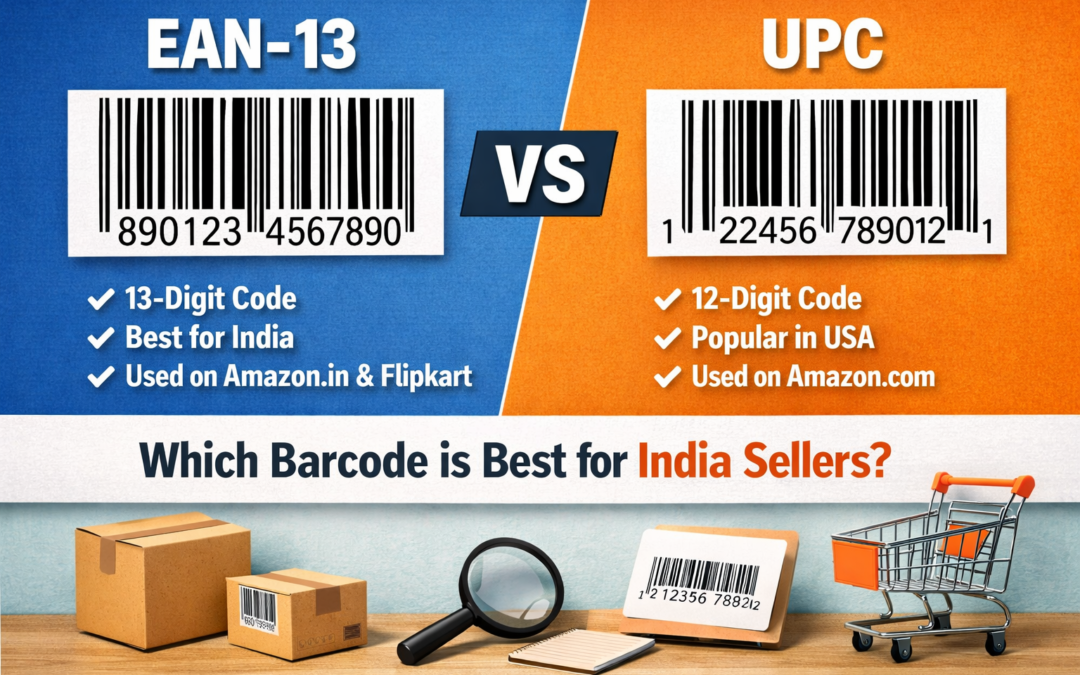
EAN-13 vs UPC: Which Barcode is Best for India Sellers?
A practical guide for Indian sellers navigating Amazon, Flipkart, and retail systems
For anyone starting or scaling a product business in India, choosing the right barcode format is one of those decisions that seems minor at first but has long-term consequences. Many sellers only realize its importance after facing listing issues, catalog mismatches, or operational challenges.
The confusion usually comes down to two options: EAN-13 and UPC. Both are valid barcode formats, both are globally recognized, and both serve the same fundamental purpose—product identification. However, they are not interchangeable in every context.
This article breaks down the difference from a practical, business-oriented perspective so you can make a decision that supports not just your current listings, but your long-term growth.
Understanding the Role of Barcodes in eCommerce
Barcodes are more than a technical requirement. They act as a standardized identity for your product across platforms, warehouses, and retail environments. Every time your product is scanned, listed, or tracked, that barcode is doing the work behind the scenes.
It influences how efficiently your product moves through supply chains, how easily it is listed on marketplaces, and how reliably it can scale across different sales channels.
Choosing the wrong format may not stop you immediately, but it often introduces friction that becomes harder to manage as your business grows.
What is EAN-13 and Why It Is Widely Used in India
EAN-13 is a 13-digit barcode format used across most global markets, including India. It is deeply integrated into retail systems, distribution networks, and eCommerce platforms operating within the country.
From supermarkets to warehouse management systems, EAN-13 is the standard that most Indian businesses rely on.
It offers compatibility not just with online marketplaces like Amazon and Flipkart, but also with offline retail environments, making it a versatile and future-ready choice.
For sellers who want flexibility across multiple channels, this consistency becomes a significant advantage.
What is UPC and Where It Fits
UPC, or Universal Product Code, is a 12-digit barcode format primarily used in the United States and Canada. It is widely accepted in North American retail systems and is commonly associated with Amazon US listings.
While UPC is a strong standard in its primary markets, its relevance in India is comparatively limited.
In most Indian selling scenarios, UPC does not provide any additional advantage and may even create unnecessary compatibility considerations.
It becomes useful mainly when your business is focused on exporting to or operating within North America.
EAN-13 vs UPC: A Practical Comparison
| Aspect | EAN-13 | UPC |
|---|---|---|
| Number Format | 13 digits | 12 digits |
| Primary Markets | India, Europe, Asia | USA, Canada |
| Marketplace Compatibility (India) | Strong | Limited |
| Retail System Support | Widely compatible | Region-specific |
| Scalability | Flexible across markets | Best for North America |
This comparison highlights an important point: the difference is not just technical—it is geographical and strategic.
What Works Best for Amazon India and Flipkart
For sellers targeting Indian marketplaces, EAN-13 aligns more naturally with platform expectations and system requirements. It integrates smoothly into product catalogs and reduces the likelihood of listing complications.
Flipkart and other Indian platforms also operate more efficiently with EAN-based product identification.
While UPC may occasionally work, it is not optimized for the Indian ecosystem, and relying on it can introduce avoidable friction.
Common Mistakes Sellers Make
Choosing a barcode format based on incomplete or globalized advice without considering the target market
Purchasing barcodes without verifying authenticity or long-term usability
Thinking only about immediate listing needs instead of future expansion
Ignoring compatibility with offline retail and distribution channels
These mistakes are often small at the beginning but can become significant obstacles as the business scales.
Thinking Beyond the First Product
Many sellers start with one or two products and assume that barcode choice is a minor detail. However, once the product line expands, the impact becomes more visible.
A scalable barcode system should support bulk listings, inventory tracking, and integration with multiple sales channels.
EAN-13 is better suited for this kind of growth because it aligns with both digital and physical retail infrastructure in India.
Final Recommendation for Indian Sellers
For businesses operating in India, EAN-13 is the most practical and reliable choice. It supports marketplace requirements, integrates with retail systems, and provides flexibility for future expansion.
UPC should be considered only when your primary focus is on North American markets.
Making the right decision at this stage helps avoid unnecessary complications and ensures a smoother path as your business grows.
Frequently Asked Questions
Is EAN-13 mandatory for Amazon India?
It is not always mandatory, but it is the most commonly used and accepted format.
Can UPC be used in India?
Yes, but it is not the preferred format for Indian marketplaces.
Which option is better for long-term growth?
EAN-13 provides better flexibility for both online and offline expansion.
Do I need a barcode for every product?
Yes, each unique product requires its own barcode.
Get Started with the Right Barcode
Choose a barcode format that supports your business today and scales with you in the future.
Buy BarcodeRead also – Buy Barcode for Amazon & Flipkart India
Continue Reading: EAN-13 Guides
Explore practical guides for product identification, packaging and retail preparation.
 Barcode for Clothing Products in India: EAN-13 Guide
Read guide →
Barcode for Clothing Products in India: EAN-13 Guide
Read guide →
 Why Retailers Reject Products With Barcode Problems | India Guide
Read guide →
Why Retailers Reject Products With Barcode Problems | India Guide
Read guide →
 Barcode for Multipack Products in India: Do You Need a New One?
Read guide →
Barcode for Multipack Products in India: Do You Need a New One?
Read guide →
 Why Is My Barcode Not Scanning? 11 Common EAN-13 Problems & Solutions
Read guide →
Why Is My Barcode Not Scanning? 11 Common EAN-13 Problems & Solutions
Read guide →