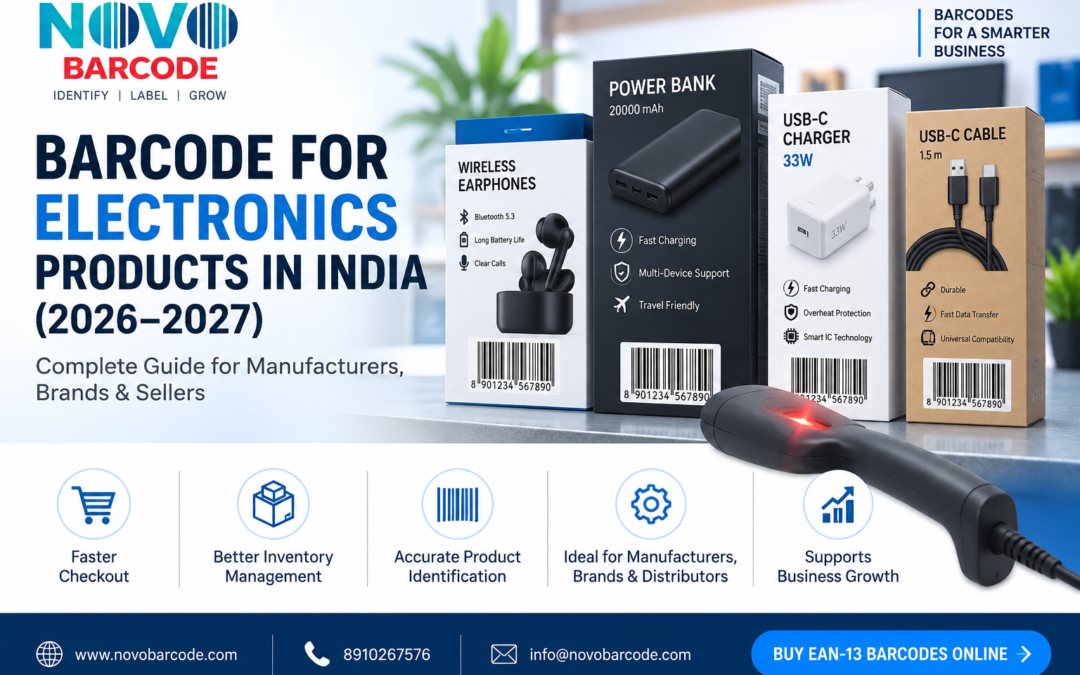
If you manufacture, import, distribute or sell electronics products in India, you may eventually need to add a barcode to your product packaging. Barcodes help businesses identify products consistently and make product handling, inventory management and retail scanning easier.
From earphones and headphones to chargers, cables, speakers, power banks, computer accessories and smart devices, electronics businesses often have multiple models, variants and packaging configurations. Managing the correct product identifier for each item is therefore important.
In this guide, we explain how EAN-13 barcodes work for electronics products in India, how variants should be handled, the difference between a barcode, SKU and serial number, and what businesses should consider before purchasing barcodes.
Do Electronics Products Need Barcodes in India?
There is no single rule that every electronic product must carry a barcode simply because it is an electronic product. However, barcodes are widely used in product identification, retail operations, inventory systems, distribution and point-of-sale scanning.
If you are building a branded electronics product line, supplying retailers or distributors, or maintaining a structured inventory system, assigning a unique product identifier and representing it as a barcode can make product management much easier.
The requirement can also depend on the retailer, distributor, marketplace, inventory system or business process you are supplying.
What Barcode Is Used for Electronics Products?
For products intended for retail identification, EAN-13 is one of the commonly used barcode formats internationally, including for many product categories sold in India.
An EAN-13 barcode contains a 13-digit number encoded into a machine-readable barcode symbol. The number identifies the product, while the printed bars allow compatible scanners to read that number.
Electronics businesses can use barcode identification for products such as:
- Earphones and headphones
- Bluetooth speakers
- Chargers and adapters
- USB cables and computer cables
- Power banks
- Computer accessories
- Keyboards and mice
- Webcams
- Mobile accessories
- Smart watches and wearable accessories
- Small electronic gadgets
- LED and electrical consumer products
Barcode vs SKU vs Model Number vs Serial Number
One of the most common mistakes made by new electronics brands is treating every product number as the same thing.
| Identifier | Purpose |
|---|---|
| Barcode / EAN-13 | Machine-readable representation of a product identifier |
| SKU | Internal stock or inventory reference created by the business |
| Model Number | Identifies a particular model or product design |
| Serial Number | Can identify an individual physical unit |
For example, an electronics company might sell a Bluetooth speaker under one model name while assigning a separate internal SKU for inventory management and a retail product identifier represented by an EAN-13 barcode.
These systems can work together rather than replacing one another.
Do Different Electronics Models Need Different Barcodes?
Usually, different products that need to be separately identified should not simply share the same product identifier.
Consider a company selling three Bluetooth speakers:
- Mini Speaker – Black
- Mini Speaker – Blue
- Mini Speaker – Red
If these are treated as separate trade items in the company’s retail or inventory system, the business may need separate identifiers for the different variants.
The exact identification structure should be decided according to how the products are sold, packaged and distinguished in the supply chain.
What About Electronics Accessories?
Electronics brands often sell dozens or hundreds of accessories rather than only complete devices.
For example, a single brand could sell:
- 20W charger
- 33W charger
- 65W charger
- USB-C cable
- Lightning-compatible cable
- Wireless charger
- Power bank
- Car charger
Although these products may look similar, they can have different specifications, prices, packaging and commercial identities.
Using a structured product-identification system helps prevent different products from being confused during inventory and retail operations.
Do Different Colours or Variants Need Different Barcodes?
This depends on whether the variation represents a separately identified trade item.
For example, a company selling the same headphones in black, white and blue may need to determine whether each colour is separately sold and managed as a distinct product.
The same consideration applies to:
- Storage capacity
- Power rating
- Wattage
- Connectivity type
- Colour
- Pack quantity
- Size
- Model revision
Before generating a large quantity of barcodes, it is better to prepare a product list containing every distinct product and variant.
How Many Barcodes Does an Electronics Brand Need?
The answer depends on the number of separately identified products and variants in your range.
For example, suppose an electronics company has:
- 10 headphone models
- 8 speaker models
- 12 chargers
- 15 cables
- 5 power banks
The company should not automatically assume that it needs exactly 50 barcodes. Product variants and packaging configurations must also be considered.
For a detailed explanation of barcode quantities, see our guide:
How Many Barcodes Do I Need for My Products?
Where Should You Put a Barcode on Electronics Packaging?
The barcode should be placed where it can be easily scanned and is not distorted by packaging folds, curves, seams or excessive printing.
Common locations include:
- Back of the retail box
- Bottom of the product box
- Side panel of the packaging
- Product label
- Hang tag or sticker
Avoid placing the barcode across a sharp packaging edge or directly over an area that may become damaged during handling.
The barcode should also have sufficient clear space around it so that scanners can distinguish the symbol from surrounding graphics and text.
Barcode Printing for Electronics Products
Buying a barcode number is only one part of the process. The barcode must also be printed clearly enough to be scanned reliably.
When preparing packaging artwork, pay attention to:
- Barcode size
- Print quality
- Contrast
- Quiet zone around the barcode
- Packaging material
- Curved surfaces
- Label quality
- Final printing resolution
A barcode that looks acceptable on a computer screen may still perform poorly if it becomes too small, distorted or low-quality during packaging production.
Barcode for Electronics Manufacturers in India
Manufacturers producing electronics under their own brand can benefit from planning barcode identification before packaging artwork is finalised.
A practical workflow is:
- Create the complete product and variant list.
- Identify which products need separate identification.
- Determine the appropriate product-identification system.
- Obtain the required numbers from the appropriate source.
- Generate the barcode artwork.
- Add the barcode to the packaging design.
- Print samples.
- Test the printed barcode with a scanner.
- Begin production after confirming the packaging artwork.
This approach can prevent costly packaging corrections later.
Barcode for Electronic Product Distributors and Wholesalers
Distributors and wholesalers often handle products from multiple brands. A consistent barcode system can make receiving, inventory tracking and dispatch operations easier.
For businesses dealing with a large product catalogue, maintaining a spreadsheet containing the following information can be useful:
- Product name
- Brand
- Model number
- SKU
- Variant
- Product identifier
- Barcode
- Pack quantity
- Product status
This makes it easier to identify which barcode belongs to which product when the catalogue becomes large.
Can One Barcode Be Used for Multiple Electronics Products?
Businesses should not simply place the same product identifier on unrelated products to reduce the number of barcodes they need.
If two products are commercially different items and need to be distinguished separately, they should be evaluated separately when creating the product-identification structure.
Using the wrong identifier can create problems when products are scanned, stocked, sold or managed in a retail system.
How to Check Your Barcode Before Printing
Before sending packaging artwork to a printer, it is a good idea to verify the barcode data and test the actual printed symbol.
You can use the NovoBarcode verification tool to check a barcode and make sure you are working with the correct information.
For additional information about checking EAN-13 barcodes, read:
How to Verify an EAN-13 Barcode in India
Barcode for New Electronics Brands
If you are launching a new electronics brand, it is better to think about barcode requirements before your packaging is printed.
Start with your complete product catalogue rather than purchasing numbers randomly for individual products.
For example, if your first launch contains:
- 5 headphones
- 5 speakers
- 10 charging products
- 15 cables
- 5 power banks
Prepare the complete catalogue first. Then determine how many separately identified products and variants you actually have.
This makes barcode management much easier as your product range grows.
Should You Buy Barcodes Before Printing Your Packaging?
Ideally, yes.
The barcode should be incorporated into the packaging design rather than added as an afterthought.
Getting the barcode information ready before printing allows your designer to reserve an appropriate space and helps reduce the chance of redesigning packaging later.
Need Barcodes for Electronics Products?
If you are launching electronics products, accessories, gadgets or electrical consumer products, NovoBarcode provides barcode services for businesses that need product barcode files.
You can review the available barcode options and choose the quantity suitable for your product range.
Buy Barcode from NovoBarcode →
If you need a specific quantity, you can also check the custom barcode quantity option.
Frequently Asked Questions
What barcode is commonly used for electronics products?
EAN-13 is a commonly used retail barcode format for product identification. The appropriate identification arrangement depends on the business and supply-chain requirements.
Do electronic accessories need separate barcodes?
Different accessories that are separately identified and sold may require separate product identifiers. Product variants should be evaluated individually.
Can I use the same barcode for different electronic products?
You should not reuse one product identifier for unrelated products simply to reduce barcode quantity. Each separately identified trade item should be evaluated appropriately.
Do different colours of an electronic product need different barcodes?
It depends on whether the different colours are treated as separately identified trade items. The business should determine this before assigning product identifiers.
Can I print an EAN-13 barcode on an electronics box?
Yes, an EAN-13 barcode can be printed on suitable product packaging, provided the barcode is produced and printed correctly and meets the requirements of the intended scanning environment.
How many barcodes does a new electronics company need?
It depends on the number of products and separately identified variants in the catalogue. Preparing a complete product list first is the best way to estimate the required quantity.
Conclusions
For electronics brands, a barcode is more than a graphic printed on a box. It is part of a broader product-identification system connecting the product with inventory, distribution and retail operations.
Whether you sell headphones, speakers, chargers, cables, power banks, computer accessories or other electronic products, planning your barcode structure before printing packaging can save time and reduce mistakes.
Start with your complete product catalogue, identify your individual products and variants, and then choose the barcode solution that matches your business requirements.