
If you are a seller or manufacturer based in Kolkata or anywhere in West Bengal, selecting the right barcode for your products is a critical step to ensure smooth retail and online sales. Whether you produce packaged food, clothing, or electronics, understanding the differences between an independent barcode and a GS1-issued GTIN can help you meet marketplace and retailer requirements more effectively.
Your packaging designer asks for a barcode. A marketplace requests a GTIN. A retailer mentions GS1. Then a barcode provider offers an EAN-13 number for immediate delivery.
These terms are related but not interchangeable. An EAN-13 barcode symbol is the visual pattern scanned at checkout. A GTIN is the product identifier encoded by that symbol. A GS1-issued GTIN is a number allocated through the GS1 system, linked to the relevant company or brand owner.
This distinction is especially important for Indian sellers. An independently supplied barcode number may be readable and useful for internal labelling or inventory, but it is not automatically a GS1-licensed identifier and may not be accepted by all marketplaces, retailers, or distributors.
Your choice should depend on where you plan to sell, who owns the product data, and what your trading partners require—not just on the barcode’s appearance.
The short answer
Choose a GS1-issued GTIN when your retailer, marketplace, distributor, export buyer, or supply-chain partner specifically requires GS1 identification, company-prefix ownership, or validation through the GS1 system.
An independent EAN-13 barcode service may be suitable if your use is limited to product labelling, internal inventory, billing, or other purposes where the receiving system does not require a GS1-issued GTIN. Confirm this suitability before ordering.
Neither option is universally accepted. A barcode that scans is not necessarily one that meets every commercial or marketplace requirement.
First, separate the four terms
Confusion arises because “barcode,” “EAN,” “GTIN,” and “GS1” are often used interchangeably, though they refer to different aspects of product identification.
| Term | What it means | Why it matters |
|---|---|---|
| Barcode symbol | The printed, machine-readable pattern of bars and spaces. | A scanner reads this symbol. |
| EAN-13 | A barcode symbology commonly used to represent a 13-digit product identifier. | It describes the format of the printed symbol, not necessarily who issued the number. |
| GTIN | A Global Trade Item Number used to identify a trade item. GTIN-13 is one form within the GTIN family. | It identifies the product or sellable configuration in a product-identification system. |
| GS1-issued GTIN | A GTIN allocated through the GS1 system under the applicable rules and issuing organisation. | It may be required where a trading partner needs GS1 ownership, allocation, or validation. |
Thus, an EAN-13 image can represent a 13-digit number, but the image alone does not prove that the number was issued by GS1. The format and the source of the identifier are separate considerations.
What is an independent barcode number?
Independent barcode providers may supply numerical identifiers and corresponding EAN-13 artwork outside the GS1 registration process. Depending on the provider, you may receive a number, a PNG or SVG barcode file, and supporting product information or verification features.
This service can suit small manufacturers, online sellers, private-label businesses, or retailers needing a scannable product code for specific operational purposes, such as linking products to billing software or inventory systems.
However, do not describe an independently supplied number as a GS1-issued GTIN unless it genuinely comes from GS1. The presence of 13 digits, a valid check digit, or phone scanability does not establish GS1 licensing or ownership.
The provider should clearly explain:
- What type of number is supplied.
- Whether it is issued through GS1 or independently.
- Where the number is intended to be used.
- Whether the service includes only artwork or also product-number allocation.
- What happens if a retailer or marketplace rejects the identifier.
What is a GS1 GTIN?
GS1 is a global standards organisation supporting product identification and supply-chain standards. A GS1-issued GTIN is allocated through the relevant GS1 member organisation and follows applicable rules for trade item identification.
In India, sellers requiring GS1-issued identification should verify the current process directly with GS1 India, as registration, fees, documentation, and renewal conditions can change over time.
The value of GS1 lies in linking the identifier to brand or company allocation, product data, and the expectations of organisations using GS1 standards.
This is especially important when supplying organised retail, large distributors, export buyers, data pools, or marketplaces that validate identifiers against recognised sources.
EAN-13 and GS1 are not competing barcode shapes
A common misconception is that one must choose between “EAN-13” and “GS1” as two different barcode formats. In reality, EAN-13 refers to the symbol format printed on retail packaging, while GS1 refers to the standards and identification system under which identifiers are allocated and managed. A GS1-issued GTIN-13 can be represented using an EAN-13 symbol.
The key questions are:
- Who issued or allocated the number?
- What product does the number identify?
- Can the intended retailer or marketplace validate it?
- Is the number connected to the correct brand owner?
- What rules apply when the product, pack, or ownership changes?
Comparison: independent barcode service vs GS1 route
| Decision factor | Independent EAN-13 service | GS1-issued GTIN |
|---|---|---|
| Identifier source | Provided outside direct GS1 registration, per provider’s model. | Allocated through the GS1 system and relevant GS1 organisation. |
| Printed format | May be supplied as an EAN-13 symbol. | Also represented as an EAN-13 symbol for retail applications. |
| Best starting question | Will the receiving system accept this identifier? | Does the business need GS1 allocation, ownership, and validation? |
| Typical appeal | Simple purchase, flexible quantity, quick digital delivery. | Recognised standards framework for broader supply-chain needs. |
| Marketplace acceptance | Depends on the marketplace’s current policy. | Still subject to marketplace category and seller rules. |
| Renewal or ongoing terms | Depend on the independent provider’s terms. | Depend on GS1 registration and licensing arrangements. |
This table is a decision aid, not a guarantee of acceptance. Before investing, confirm requirements with your retailer or platform.
When should an Indian seller consider GS1?
GS1 is advisable when the receiving organisation requires GS1-issued GTINs or documentation. Common indicators include:
- A marketplace specifically requests a GS1-issued GTIN.
- An organised retailer requires GS1 identification during onboarding.
- A distributor needs to validate identifiers against a recognised database.
- An export buyer provides a written barcode or product-identification specification.
- Your brand plans a formal supply-chain data structure across multiple retail partners.
- You are the brand owner needing a long-term allocation system for a growing catalogue.
Choose GS1 because the business requirement calls for it, not merely because the product has an EAN-13 image.
When might an independent EAN-13 service be considered?
An independent service may be suitable when the intended use is limited and the receiving party does not require GS1-issued identification. Examples include internal inventory, small retailer billing, product labels for defined processes, or when the buyer confirms acceptance of independent numbers.
This is a suitability decision, not a universal rule. A small seller supplying a neighbourhood store in Kolkata or West Bengal may have different requirements than a brand supplying national retail chains. Local food businesses selling directly may have different identification needs than manufacturers working with large supermarket distributors.
Always confirm acceptance with the specific channel before ordering. “It scans” does not guarantee acceptance if the buyer verifies issuer, ownership, or database records.
Marketplace and retailer acceptance: the check sellers often skip
Many sellers ask if a barcode will work on Amazon, Flipkart, Meesho, supermarkets, or other marketplaces. There is no universal answer because platform policies vary by category, seller account, brand status, and over time.
A product identifier may be valid but rejected because:
- The platform requires a GS1-issued GTIN.
- The identifier is already linked to another product in the platform catalogue.
- The brand name and product information do not match submitted data.
- The category has separate exemption or documentation processes.
- The marketplace has updated seller requirements.
Check current seller documentation and, where possible, ask the platform or retailer before printing packaging. Keep written records of responses, as informal assurances may not suffice later.
Product ownership matters for private-label businesses
Private-label arrangements carry specific risks. The manufacturer may produce the item, but the product is sold under the brand owner’s name. The manufacturer’s existing identifier should not be copied onto the private-label product without agreement.
Before production, brand owner and manufacturer should agree on:
- Who owns the product identification number.
- Which company supplies the product data.
- Whether the product is sold under the manufacturer’s brand or private label.
- Who manages changes to pack size, formulation, design, or product status.
- Which identifier standard each retailer or marketplace requires.
If organised retail is a goal, this discussion should occur before packaging is printed. Correcting ownership or identifier issues after production can cause relabelling, listing, and inventory challenges.
Do not confuse a barcode with an SKU
An SKU is an internal stock-keeping code created by your business, such as TEA-ASSAM-250 or TS-BLK-M. An EAN-13 symbol encodes a numeric product identifier used by compatible systems. A GS1-issued GTIN is part of a broader standards-based identification system.
Your product master sheet can include:
| Field | Example |
|---|---|
| Product | Assam Black Tea |
| Variant | Loose leaf |
| Pack size | 250 g |
| Internal SKU | TEA-ASSAM-250 |
| Product identifier | Assigned number |
| Identifier source | GS1-issued or independent service |
| Barcode artwork file | Approved EAN-13 artwork |
| Sales channels | Own website, local retail, marketplace |
Maintaining the identifier source prevents confusion about whether a 13-digit number is GS1-issued.
How many identifiers do you need?
Start with sellable trade items, not brand names. New identifiers may be needed for differences such as:
- Net quantity or pack size.
- Flavour, shade, colour, or formulation.
- Model, capacity, or technical specification.
- Physical multipack or gift-set configuration.
- Any change that makes the item separately ordered, priced, stocked, or sold.
For example, a private-label spice brand selling turmeric in 100 g and 500 g packs, chilli powder in the same sizes, and a three-product gift set should not assume one number covers all. Each sellable configuration should be mapped and identification rules confirmed.
Artwork redesign alone may not always require a new identifier, but new pack sizes usually do. When using GS1 identifiers, follow current GS1 rules rather than relying on simple online formulas. For more, see the Product Variant Guide for India.
Printing and scanning are separate from identifier choice
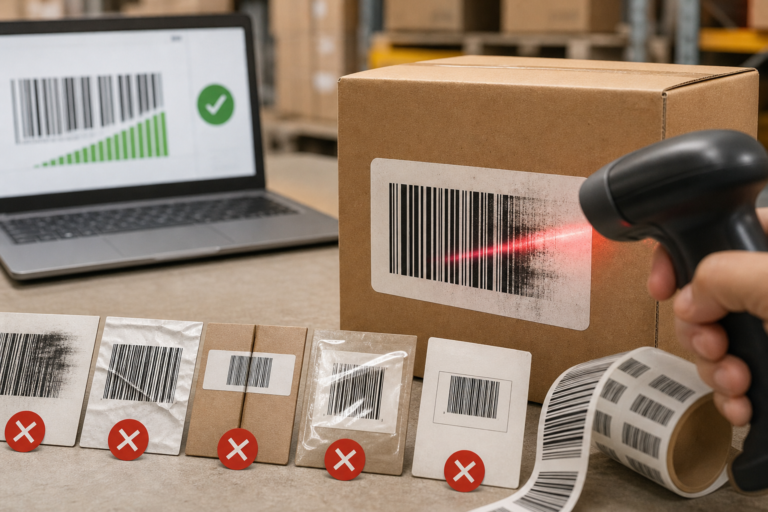
Even the correct identifier can fail at checkout if the printed barcode is poor. Before large print runs, check:
- The number in the artwork matches the approved product record.
- The barcode is not stretched or compressed.
- Quiet zones remain clear.
- Contrast is strong enough for the intended scanner.
- The symbol is not placed across folds, seams, curves, or reflective surfaces.
- The final printed sample scans with suitable equipment.
Phone scans are useful first checks but do not guarantee acceptance by all retail scanners or marketplaces. Identifier source, product-data validation, and print quality are distinct considerations.
Questions to ask before buying
- Where will the product be sold first?
- Does that channel require a GS1-issued GTIN?
- Who owns the brand and product data?
- Are the products, variants, and multipacks clearly mapped?
- What exactly will the provider deliver: a number, artwork, or both?
- Is the provider independent of GS1, and is that stated clearly?
- Will the retailer or platform validate the identifier in a database?
- Have you tested the actual printed symbol before bulk production?
Conclusion
Choosing between an independent barcode number and a GS1-issued GTIN requires understanding their source, ownership, validation, and suitability for your sales channels. Both may appear as EAN-13 symbols, but their acceptance can vary depending on retailer, marketplace, or distributor requirements.
If your trading partners specifically require GS1 identification, it is advisable to follow that requirement and verify the current process with GS1 India. For uses limited to confirmed internal or business workflows that accept independent EAN-13 services, the independent route may be appropriate—provided you have confirmed acceptance.
Before purchasing, clearly document your products, variants, pack configurations, sales channels, and identifier sources. Consult your receiving parties to understand their current requirements, keep their responses with your product records, and test printed barcodes before mass production. This careful planning helps avoid costly relabelling or listing issues and supports smoother market entry in Kolkata, West Bengal, and beyond.
Continue Reading: EAN-13 Guides
Explore practical guides for product identification, packaging and retail preparation.