
Private-label food products are becoming increasingly popular in India. Many businesses are launching food brands without owning their own manufacturing facilities. Instead, they work with third-party manufacturers, contract manufacturers or food-processing companies to produce products under their own brand name.
From spices and snacks to sauces, pickles, dry fruits, bakery products and ready-to-eat foods, private-label businesses are entering the market with new products every year.
One important part of preparing these products for retail and distribution is product identification. If you are searching for a barcode for private label food products in India, this guide explains what brand owners and manufacturers should consider before printing their packaging.
What Is a Private-Label Food Product?
A private-label food product is generally manufactured by one company but sold under another company’s or brand’s name.
For example, a business may launch its own brand of:
- Turmeric powder
- Chilli powder
- Garam masala
- Namkeen
- Cookies
- Pickles
- Tomato sauce
- Dry fruits
- Ready-to-eat meals
The manufacturer produces the product while the brand owner markets and sells it under its own brand identity.
This business model allows entrepreneurs and established companies to expand their product range without necessarily building their own manufacturing plant.
Why Do Private-Label Food Brands Need Barcodes?
When a private-label brand starts selling through retailers, distributors, supermarkets or other organised sales channels, product identification becomes increasingly important.
A barcode provides a machine-readable representation of a product identifier and can help connect a physical product with information maintained in a retail or inventory system.
For a private-label food business, barcode-based identification can support:
- Retail billing
- Inventory management
- Product identification
- Stock tracking
- Warehouse management
- Distributor operations
- Product cataloguing
- Retail product scanning
Who Should Own the Product Barcode: Manufacturer or Brand Owner?
This is one of the most important questions for private-label businesses.
The answer depends on the product-identification arrangement, the business relationship, the intended sales channels and the requirements of the relevant retailer or marketplace.
A brand owner should not automatically assume that the barcode belongs to the manufacturer simply because the manufacturer produces the physical product.
Before launching a private-label product, the brand owner and manufacturer should clearly establish who is responsible for product identification and how the product will be represented in retail and inventory systems.
If an official GS1-issued GTIN is specifically required, the business should follow the appropriate GS1 process and requirements.
EAN-13 Barcode for Private-Label Products
EAN-13 is a widely used retail barcode format based on a 13-digit GTIN.
It is commonly seen on retail products including food, beverages, cosmetics, clothing, household goods and other consumer products.
For a private-label food brand, the barcode can be incorporated into suitable product packaging or labels where a retail barcode is required.
However, businesses should distinguish between the EAN-13 barcode format and the organisation that assigns the underlying GTIN.
If a retailer, marketplace or business partner specifically requires GS1-issued identifiers, confirm those requirements before ordering.
Does a Private-Label Brand Need a Separate Barcode?
A private-label business should not simply copy or reuse the barcode belonging to the manufacturer’s existing product.
If the private-label product is a distinct trade item sold under the brand owner’s product identity, the appropriate product-identification structure should be determined before packaging is printed.
For example, imagine a manufacturer produces turmeric powder for several different brands.
Brand A may sell the product as: Brand A Premium Turmeric Powder – 500 g.
Brand B may sell a different product under: Brand B Natural Turmeric Powder – 500 g.
Even if the same manufacturer produces both products, the brand and product identification requirements can be different.
Do Different Pack Sizes Need Different Barcodes?
Pack size is particularly important for private-label food businesses.
Suppose a brand launches its own chilli powder in four sizes:
- 100 g
- 200 g
- 500 g
- 1 kg
These different configurations may need to be treated as separate trade items for product identification purposes.
Therefore, businesses should prepare their complete product list before ordering barcodes.
Example: Barcode Planning for a Private-Label Spice Brand
| Product | Pack Size | Internal SKU |
|---|---|---|
| Turmeric Powder | 100 g | TUR-100 |
| Turmeric Powder | 500 g | TUR-500 |
| Chilli Powder | 100 g | CHI-100 |
| Chilli Powder | 500 g | CHI-500 |
| Garam Masala | 100 g | GAR-100 |
Maintaining a master product sheet like this can help prevent mistakes when the packaging designer, manufacturer and brand owner are working together.
Barcode for Private-Label Snacks
Private-label snack brands can have dozens of product variations.
Examples include:
- Bhujia
- Namkeen
- Mixture
- Roasted peanuts
- Chips
- Flavoured snacks
- Cookies
Different flavours, pack sizes and product variants should be clearly documented before barcode assignment and packaging production.
Barcode for Private-Label Pickles and Sauces
Pickles, sauces, jams and chutneys are also popular private-label categories.
A business may launch mango pickle in 200 g and 500 g packs while also selling mixed pickle and chilli pickle.
Instead of managing these products informally, create a structured catalogue containing the product name, variant, pack size, SKU and applicable barcode.
Barcode for Private-Label Dry Fruits
Dry-fruit businesses often have many pack-size variations.
For example:
- Almonds 100 g
- Almonds 250 g
- Almonds 500 g
- Cashews 100 g
- Cashews 250 g
- Mixed Dry Fruits 500 g
As the product catalogue expands, barcode management becomes more important for inventory and retail operations.
Barcode for Private-Label Food Products Sold Online
Many private-label brands now use a combination of offline and online sales channels.
- Own website
- Online marketplaces
- Supermarkets
- Local retailers
- Distributors
- Wholesale networks
- Quick-commerce channels
However, every marketplace or retailer can have its own product-listing and barcode requirements.
Therefore, before ordering a large barcode package, check the current requirements of the specific marketplace or retail partner where you intend to sell.
Barcode vs SKU for a Private-Label Brand
A barcode and an SKU are different things.
An SKU is generally an internal code created by the business for inventory management.
An EAN-13/GTIN is a product identifier used in applicable product-identification systems.
For example:
Product: Premium Chilli Powder 500 g
SKU: CHI-500
EAN-13: Applicable product identifier
A business can store both the SKU and barcode information in its product database.
How Many Barcodes Does a Private-Label Brand Need?
There is no universal number.
The requirement depends on the number of distinct products and product configurations the brand intends to sell.
For example, a new food brand may start with:
- 5 spice products
- 5 snack products
- 3 pickle products
- 2 sauces
If several of these products are offered in different pack sizes, the total number of product configurations can increase considerably.
The best approach is to prepare the complete product list first and then determine the number of applicable identifiers required.
What Should Be Checked Before Printing the Barcode?
Before sending your packaging artwork to the printer, check:
- Product name
- Brand name
- Product variant
- Pack size
- Internal SKU
- Applicable product identifier
- Barcode image quality
- Barcode placement
- Marketplace requirements
- Retailer requirements
A physical packaging sample should ideally be tested for scanability before a large printing run.
Can NovoBarcode Help Private-Label Food Brands?
NovoBarcode provides digital EAN-13 barcode services for businesses that require applicable barcode numbers and barcode image files for product identification and labelling purposes.
The service can be useful for private-label businesses working with food manufacturers, packaging companies and retail channels.
Popular use cases include:
- Private-label food brands
- Spice brands
- Snack brands
- Bakery brands
- Pickle brands
- Sauce brands
- Dry-fruit brands
- FMCG startups
- D2C food businesses
Bulk Barcode Packages for Growing Private-Label Brands
Private-label businesses often launch multiple products at once.
NovoBarcode provides different quantity options, including:
- 1 Barcode
- 5 Barcodes
- 10 Barcodes
- 25 Barcodes
- 50 Barcodes
- 100 Barcodes
- 200 Barcodes
This allows businesses to choose a package according to their current product requirements.
Businesses planning future product launches should maintain a product master list so that additional identifiers can be planned when new products are introduced.
Instant Digital Barcode Delivery
Packaging projects often work with tight deadlines. A food brand may already have its packaging design, product photography and manufacturing schedule prepared.
NovoBarcode’s online process provides applicable barcode information and digital barcode image files after successful payment.
This makes the digital files available for use in the packaging and labelling workflow.
Can Barcode Information Be Updated?
Private-label brands can sometimes change their product information after launch. Examples include changes to product descriptions, pack information or other catalogue details.
For applicable provider-managed information, NovoBarcode can provide support for corrections or updates.
However, businesses should distinguish provider-managed information from official GS1 records. Changes to official GS1 records must follow the applicable GS1 process.
Does Having a Barcode Improve Google Rankings?
A barcode itself does not directly improve Google rankings.
A barcode primarily identifies a product for applicable retail, inventory and product-management systems.
Google visibility depends on factors such as:
- Useful product content
- Search intent
- Website quality
- Technical SEO
- Internal linking
- Product-page information
- Website authority
- Overall relevance
A product page may be crawled and indexed by Google, but no barcode provider should guarantee that a product page will rank or be indexed within a specific number of days.
Private-Label Barcode Checklist
- ✓ Finalise your product catalogue
- ✓ List every product variant
- ✓ Record every pack size
- ✓ Create internal SKUs
- ✓ Confirm the required product-identification standard
- ✓ Check marketplace requirements
- ✓ Check retailer requirements
- ✓ Obtain applicable barcode numbers
- ✓ Add the barcode to packaging artwork
- ✓ Test the printed barcode before mass production
Related Barcode Guides
- Barcode for Packaged Food Products in India
- Barcode for Cosmetics Products in India
- Barcode for Clothing Products in India
- Buy EAN-13 Barcode Online India
Conclusion
Private-label food businesses have a unique advantage: they can build their own brand while working with experienced manufacturers to produce the products.
But successful product launches require more than attractive packaging. Product identification, SKU management, barcode planning and retail requirements should be considered before the packaging goes into mass production.
If you are launching a private-label food brand in India, prepare your product catalogue first. Record every product, variant and pack size, then determine the appropriate product-identification requirements for your intended sales channels.
If your business requires official GS1-issued identifiers, follow the appropriate GS1 process. If you are looking for an applicable digital EAN-13 barcode service, NovoBarcode provides online ordering, multiple quantity options and digital barcode delivery.
Frequently Asked Questions
What is a private-label food product?
A private-label food product is generally manufactured by one company and sold under another company’s or brand’s name.
Does a private-label food brand need a barcode?
Barcode requirements depend on the intended retail, marketplace, distribution and inventory environment. Many organised retail environments use barcode-based product identification.
Can I use the manufacturer’s barcode for my private-label product?
Do not automatically reuse a manufacturer’s existing barcode. Determine the appropriate product-identification structure for your own branded product and check the requirements of your intended sales channels.
Does every pack size need a separate barcode?
Different pack sizes may represent different trade items. The appropriate identification structure should be confirmed based on the products and sales environment.
Can I buy EAN-13 barcodes online for my food brand?
Yes, digital EAN-13 barcode services are available online. However, businesses should confirm whether their retailer or marketplace requires identifiers from a particular source such as GS1.
Can NovoBarcode provide bulk barcodes?
Yes. NovoBarcode offers quantity options ranging from individual barcodes to bulk packages for businesses with larger product catalogues.
Can a barcode help my product rank on Google?
No. A barcode is primarily a product identifier. Google rankings depend on SEO, content quality, relevance, technical factors and other search signals.
Continue Reading: EAN-13 Guides
Explore practical guides for product identification, packaging and retail preparation.
 Barcode for Clothing Products in India: EAN-13 Guide
Read guide →
Barcode for Clothing Products in India: EAN-13 Guide
Read guide →
 Why Retailers Reject Products With Barcode Problems | India Guide
Read guide →
Why Retailers Reject Products With Barcode Problems | India Guide
Read guide →
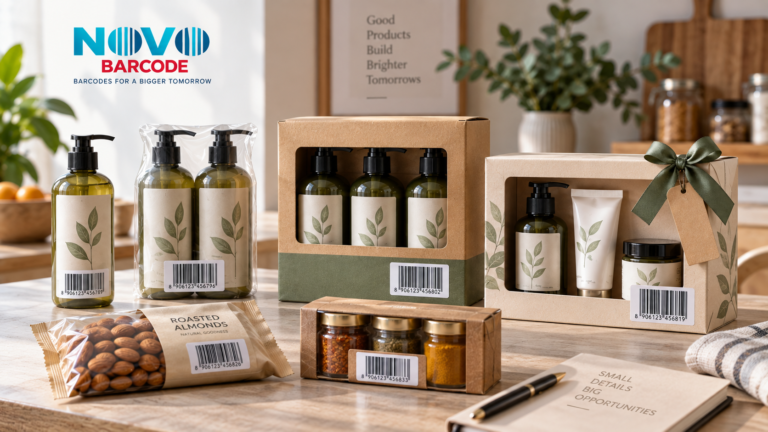 Barcode for Multipack Products in India: Do You Need a New One?
Read guide →
Barcode for Multipack Products in India: Do You Need a New One?
Read guide →
 Why Is My Barcode Not Scanning? 11 Common EAN-13 Problems & Solutions
Read guide →
Why Is My Barcode Not Scanning? 11 Common EAN-13 Problems & Solutions
Read guide →