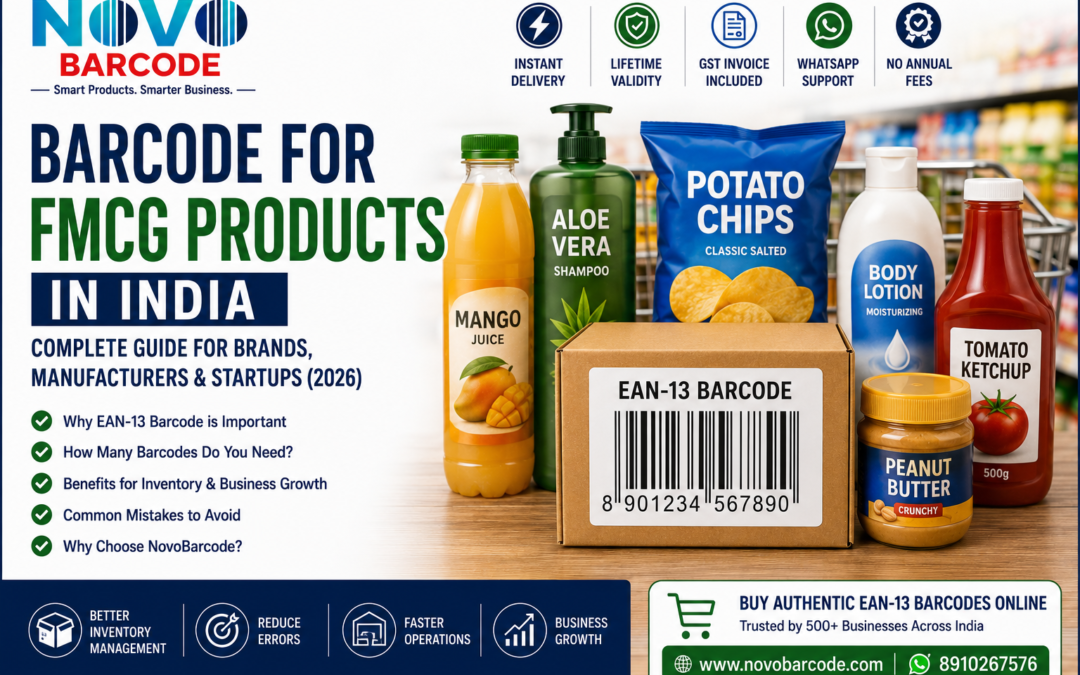
The FMCG (Fast-Moving Consumer Goods) industry is one of the largest and fastest-growing sectors in India. Every day, millions of consumers purchase packaged food, beverages, personal care products, household cleaning products, health products, and other consumer goods.
Whether you are launching a new FMCG brand or expanding an existing product line, proper product identification is essential for managing inventory, tracking stock, and organizing business operations.
This is where barcode plays an important role.
Many startups focus heavily on packaging design, marketing campaigns, product quality, and distribution networks but often overlook barcode planning during the early stages of growth.
However, as product ranges expand and inventory becomes more complex, barcode becomes one of the most important tools for operational efficiency.
In this guide, you’ll learn how EAN-13 barcode works for FMCG products, why it matters, common mistakes to avoid, and why many growing brands choose NovoBarcode.
What Is an FMCG Product?
FMCG stands for Fast-Moving Consumer Goods.
These are products that are purchased frequently by consumers and typically have a high sales volume.
Examples include:
- Packaged food
- Snacks
- Tea and coffee
- Spices
- Beverages
- Shampoo
- Soap
- Toothpaste
- Cosmetics
- Detergents
- Household cleaners
- Baby care products
- Personal care products
Unlike industrial products, FMCG products move quickly through the supply chain.
This makes inventory management extremely important.
Why FMCG Products Need Barcode
As FMCG businesses grow, product management becomes increasingly complicated.
A company may start with only a few products but eventually expand into:
- Multiple product categories
- Different packaging sizes
- Different flavors
- Different variants
- Different promotional packs
Without barcode identification, inventory confusion can occur very quickly.
Barcode helps businesses:
Product Identification
Each product can be uniquely identified.
Inventory Tracking
Track stock movement more efficiently.
Warehouse Management
Improve storage and stock organization.
Retail Operations
Simplify billing and product recognition.
Business Reporting
Improve inventory visibility and operational control.
Challenges FMCG Brands Face Without Barcode
Many small manufacturers initially rely on spreadsheets and manual stock tracking.
This often works for a short period.
However, as product numbers increase, several problems begin to appear.
Inventory Mismatch
Physical stock may not match inventory records.
Wrong Product Dispatch
Incorrect product variants may be shipped.
Stock Tracking Issues
Difficulties arise when monitoring product movement.
Slow Operations
Manual product identification takes more time.
Business Growth Limitations
Scaling operations becomes increasingly difficult.
Barcode helps solve these problems by creating a structured inventory system.
Why EAN-13 Is Popular for FMCG Products
EAN-13 is one of the most widely used barcode formats globally.
It consists of 13 digits and is commonly used for consumer products.
Benefits include:
- Easy product identification
- Inventory management support
- Retail compatibility
- Warehouse integration
- Business scalability
Many FMCG businesses prefer EAN-13 because it provides a simple and effective product identification system.
Read More:
FMCG Product Variations and Barcode Requirements
One of the biggest misconceptions among manufacturers is that one barcode can cover all product variations.
In reality, different variations often require separate identification.
Example
Suppose a company sells potato chips.
Available in:
- 50g Pack
- 100g Pack
- 200g Pack
Although the flavor is identical, inventory systems treat these as separate products.
Result:
- 50g = 1 barcode
- 100g = 1 barcode
- 200g = 1 barcode
Total = 3 barcodes
Barcode for Food Products
Food products are among the largest FMCG categories.
Common examples:
- Spices
- Pickles
- Snacks
- Bakery items
- Tea
- Coffee
- Dry fruits
Most food businesses sell multiple pack sizes.
For example:
- 100g
- 250g
- 500g
- 1kg
Each variation requires proper inventory identification.
Read More:
Barcode for Personal Care Products
Personal care products include:
- Shampoo
- Soap
- Face wash
- Lotion
- Hair oil
- Cosmetics
These products often have multiple sizes and variants.
Example:
Face Wash
- 50ml
- 100ml
- 200ml
Inventory systems manage these as separate products.
Barcode helps organize stock accurately.
Read More:
Can One Barcode Be Used for Multiple FMCG Products?
This is one of the most common questions asked by manufacturers.
Many businesses try to reduce costs by assigning one barcode to multiple products.
However, this often creates inventory problems.
Different products should generally have separate identification.
Examples:
- Different flavors
- Different pack sizes
- Different variants
- Different product categories
Using separate barcode identification improves inventory accuracy.
Read More:
How Many Barcodes Does an FMCG Brand Need?
The answer depends entirely on product variations.
Example 1
10 different products
Result:
10 barcodes
Example 2
5 products with 2 sizes each
Result:
10 product variations
10 barcodes
Example 3
3 products with 4 pack sizes
Result:
12 product variations
12 barcodes
Useful Guides:
Common Barcode Mistakes FMCG Brands Make
Buying Too Few Barcodes
Businesses underestimate future growth.
Buying Too Many Barcodes
Some businesses purchase more than they actually need.
Ignoring Product Variations
This causes inventory confusion later.
No Inventory Planning
Many businesses think about barcode only after operational problems arise.
Planning barcode requirements early helps avoid these issues.
How Barcode Supports FMCG Business Growth
As businesses scale, inventory management becomes more important.
Barcode helps:
Improve Inventory Accuracy
Better stock visibility.
Reduce Human Errors
Less manual product handling.
Improve Warehouse Efficiency
Organized storage and retrieval.
Support Expansion
Easier management of larger product catalogs.
Better Business Control
Clearer product tracking across operations.
Businesses that implement structured barcode systems early often scale more efficiently.
Why Growing FMCG Brands Choose NovoBarcode
Today there are many barcode providers available.
However, manufacturers often need more than barcode numbers.
They need:
- Fast delivery
- Flexible quantity options
- Reliable support
- Business-friendly service
NovoBarcode is designed specifically to help growing businesses.
Benefits of Choosing NovoBarcode
✔ Instant barcode delivery
✔ Authentic EAN-13 barcode solutions
✔ Flexible barcode quantity purchase
✔ GST invoice included
✔ WhatsApp support
✔ Lifetime validity
✔ No annual renewal fees
✔ Suitable for startups and manufacturers
Many FMCG startups prefer purchasing barcode quantities based on actual product requirements instead of investing in unnecessarily large packages.
NovoBarcode makes this process simple.
Who Should Buy Barcode for FMCG Products?
Barcode is valuable for:
- Food manufacturers
- Beverage brands
- Spice companies
- Snack brands
- Personal care brands
- Cosmetic businesses
- Household product manufacturers
- FMCG startups
If you plan to scale your product range, barcode planning should be part of your business strategy.
Conclusion
The FMCG industry is highly competitive.
As product catalogs expand and inventory becomes more complex, barcode plays a critical role in product identification and inventory management.
Whether you manufacture food products, personal care products, household items, or consumer goods, implementing barcode systems early can help create a stronger foundation for business growth.
EAN-13 barcode remains one of the most practical solutions for FMCG brands looking to improve organization, reduce inventory errors, and scale efficiently.
If you’re launching or expanding an FMCG brand, proper barcode planning today can save significant operational challenges in the future.
Frequently Asked Questions
Do FMCG products need barcode?
Barcode helps improve product identification, inventory management, and stock tracking.
How many barcodes does an FMCG business need?
The number depends on product variations, sizes, flavors, and packaging formats.
Can one barcode be used for multiple products?
Different product variations should generally have separate identification.
Is EAN-13 suitable for FMCG products?
Yes. EAN-13 is one of the most widely used barcode formats for consumer products.
Why choose NovoBarcode?
NovoBarcode offers instant delivery, flexible quantities, GST invoices, WhatsApp support, lifetime validity, and startup-friendly pricing.
Where can I buy EAN-13 barcode online?
👉 https://novobarcode.com/product/custom-barcode-quantity/
📞 WhatsApp: 8910267576